
Gascoyne River flows through Carnarvon following Cyclone Narelle deluge
Satellites have captured muddied floodwater flowing out of the Gascoyne River into the Indian Ocean as rainfall from Tropical Cyclone Narelle continues to flow through Carnarvon.
Heavy rain fell over Western Australia’s Gascoyne district last Friday as Tropical Cyclone Narelle made landfall and carried a huge amount of tropical moisture over northwestern Australia.
Narelle's landfall caused more than 100 mm of rain to soak parts of the Gascoyne River catchment, with 112 mm falling at Dalgety Downs Airstrip and 108 mm at Winderie Airstrip during the 24 hours to 9 am AWST on Saturday, March 28, 2026.
This heavy inland rain fed into the Gascoyne River over the weekend, causing the ephemeral river – meaning it only flows following rain – to rise rapidly.
Locals watched on in excitement as the river started flowing under Nine Mile Bridge on Sunday evening, March 29. The water started passing beneath the bridge around 7pm AWST on Sunday and by 7 am Monday, just 12 hours later, the river had risen by 7.8 metres.
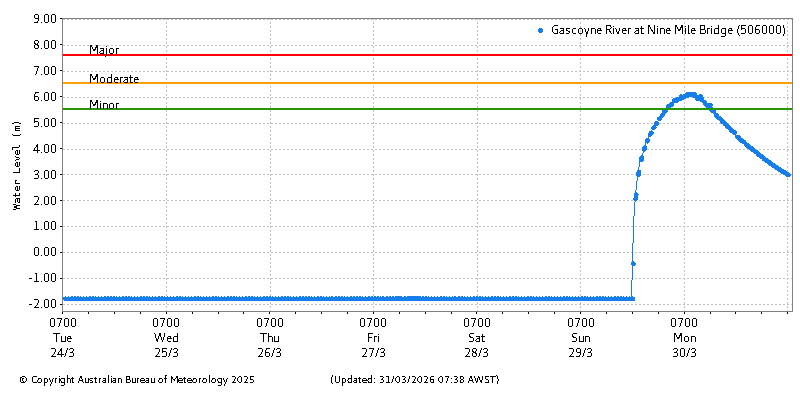
Image: River height observations over the past week for the Gascoyne River and Nine Mile Bridge in WA, showing floodwater arriving from Sunday evening. Source: Bureau of Meteorology.
The river level at Nine Mile Bridge peaked in the early hours of Monday morning and has been steadily dropping throughout Monday into Tuesday, in response to drier weather across the region.
The satellite images below show muddied floodwater flowing into the Indian Ocean from the Gascoyne River on Monday.
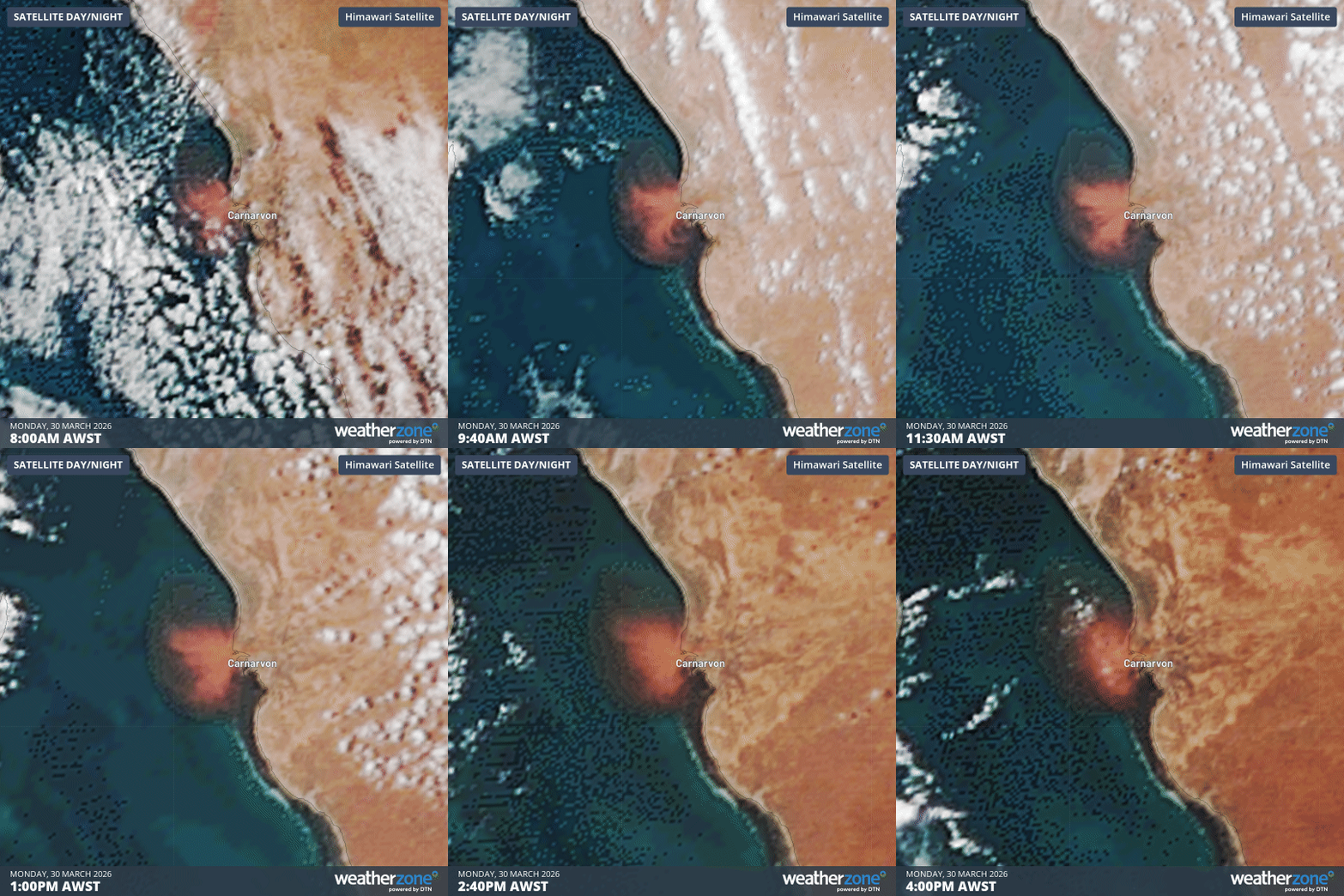
Images: Visible true colour satellite images showing floodwater from the Gascoyne River flowing into the Indian Ocean near Carnarvon, WA. Source: Weatherzone.
Drier weather will persist over northwestern Australia for at least the remainder of this week, allowing floodwater to gradually recede.
At this stage there are no signs of heavy rain or tropical cyclone activity in WA during the next two weeks. However, further rain is possible in the coming weeks as the wet season officially runs until the end of April.