
Why do clouds float?
Clouds are made up of water droplets and ice crystals. So, why don’t they fall to the ground?
Clouds appear to defy gravity by hovering above Earth’s surface every day. If you can’t see any in the sky above you, a quick look at the latest images from a weather satellite will show a variety of cloud formations stretching across the planet.
Being an everyday occurrence, a cloud’s ability to hang in the sky might seem unimpressive. But have you ever wondered how clouds manage to float while other precipitation, including rain, hail and snow, fall to the ground?
Perfect balance between gravity, buoyancy and updrafts
A cloud's ability to float comes down to a delicate balance of forces: gravity against buoyancy and updrafts.
In the context of Earth’s atmosphere, gravity is the force that pulls objects towards the ground. It acts on everything in the sky, including clouds. It never switches off. If you throw a ball in the air, gravity is what brings it back down.
There are also other forces that oppose gravity in the atmosphere, including buoyancy and updrafts.

Image: Low-level clouds are usually composed of small water droplets while high clouds often contain tiny ice crystals. Source: iStock / guvendemir.
You may be familiar with buoyancy in water – it’s the force that keeps boats and rubber duckies afloat. But the atmosphere also has buoyancy that tries to push objects upwards in the opposite direction to Earth’s gravitational pull. However, the buoyancy of air is much weaker than the buoyancy of water, which is why boats can’t fly.
Why updrafts matter
Rising air currents – known as updrafts – also oppose the force of gravity in the atmosphere and the stronger the updraft, the more it acts against gravity when an object is trying to fall.
If an object is small enough, the upward force of buoyancy and rising air currents can match or exceed the downward force of gravity.
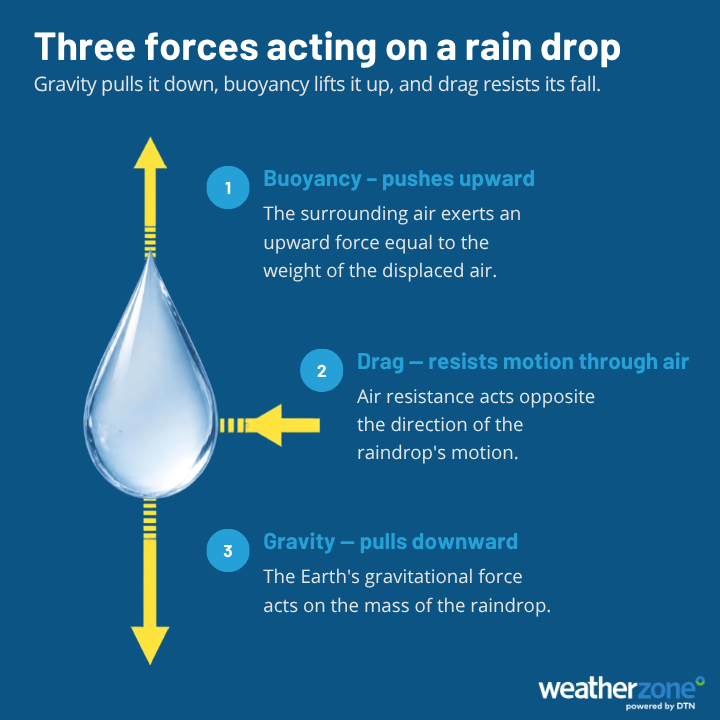
Image: Three main forces acting on rain drops and cloud droplets. Source: Weatherzone.
Cloud droplets are so small – typically less than 0.02 mm in diameter – that the force exerted on them by Earth’s gravity is also small. In areas where relatively warm air is rising in the sky, this small gravitational force is counteracted by this updraft and the atmosphere’s buoyancy. Cloud droplets are so small that they fall very slowly, meaning even a weak updraft can keep them afloat.
What happens when cloud droplets get too big?
The small size of cloud droplets is the key to clouds being able to hover in the sky. When cloud droplets start to get too large, their mass increases the force of gravity, which eventually outweighs the opposing force of buoyancy and rising air currents, causing them to fall towards the ground. Some raindrops can grow to around 6 mm in diameter.
An important note about raindrops is that small changes in their size make a surprisingly big difference to their weight. Double the width of a droplet and its volume increases eightfold. When water droplets in clouds get too heavy, they fall as rain, hail or snow.
Next time you see a cloud in the sky, take a moment to stop and appreciate the natural balancing act taking place in the atmosphere.