
Vast extent of 2022 Great Barrier Reef mass bleaching revealed
A report released today by the Great Barrier Reef Marine Park Authority has confirmed a sixth mass bleaching event on the Reef, with 91 percent of 719 reefs assessed showing at least some bleaching.
The Reef Snapshot: Summer 2021/22 used data from an aerial survey of reef community coral bleaching throughout the Great Barrier Reef in March.
As you can see from the image below, the central part of the reef was the worst affected.
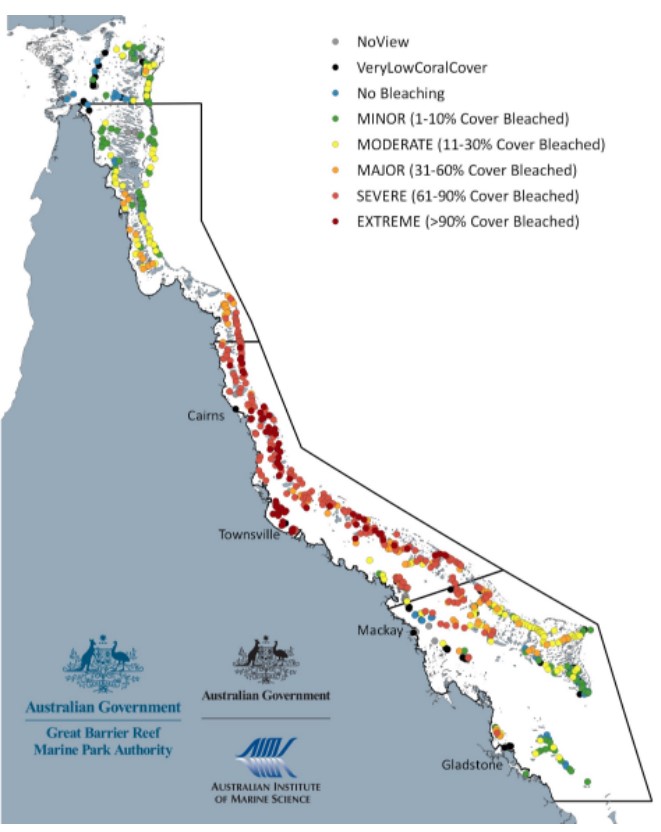
Image: Not the sort of colour you want to see on the Reef. Source: GBRMPA.
This 2022 bleaching is the sixth recorded mass-bleaching in the last 25 years – the others were in 1998, 2002, 2016, 2017 and 2020.
All were caused by abnormally warm ocean temperatures, which are driven in part by global warming.
This bleaching event is particularly unusual because it occurred during a La Niña climate state which normally provides sufficient cooling (via increased cloud cover) to limit heating at the surface, which typically prevents bleaching.
But this time, the warmth from warmer waters prevailed. Weatherzone meteorologist Jess Miskelly called it a "scary tipping of the scales that hasn't been seen before".
Warm water anomalies persist off much of the Queensland coast, as you can see on the BoM's latest sea temp anomaly chart for Queensland, issued this week.
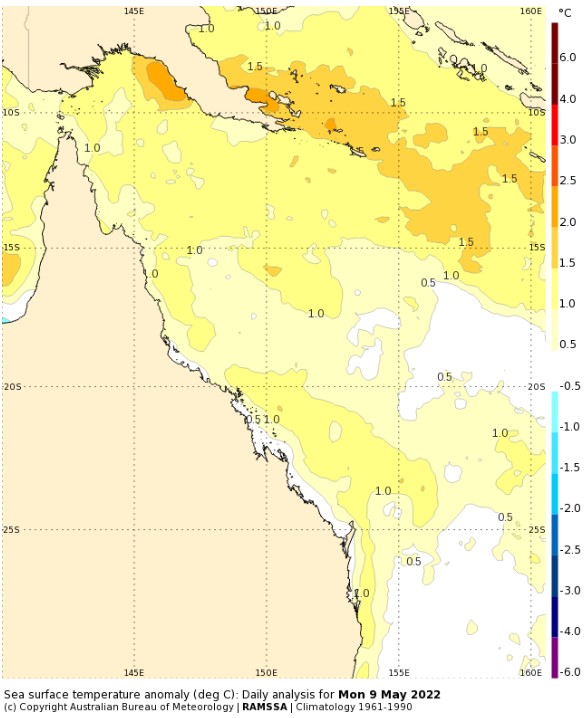
Image: Queensland waters, warm one day, warmer than usual the next. Source: BoM.
This report would ordinarily have been made available to the public weeks ago, however it was delayed because the government is in caretaker mode ahead of the Federal Election on May 21.
Earlier this week, leading reef scientist Professor Terry Hughes, of James Cook University, said it was "disappointing" it had not yet been released.
With the release of the report, what will likely be disappointing now for most Australians is the current state of a national icon and major tourism drawcard.
REMIND ME: WHAT IS BLEACHING AND CAN CORAL RECOVER?
- When corals are under stress (such as heat stress from unusually warm water), they expel the microscopic algae that live in their tissues. That turns their tissues transparent, exposing their white skeleton, which is how you get the bleaching effect.
- Bleached corals are not dead, however they are more at risk of starvation and disease. They can recover from a bleaching event, but that takes time and is dependent on water returning to normal temperatures – as well as an absence of major disturbances such as tropical cyclones.
- There's a comprehensive story here on what it takes for corals to survive, and which corals are better suited to surviving heat stress than others.