
Uluru’s wettest day in a decade as heavy rain targets central Australia
More than 100 mm of rain has fallen at Uluru over the last two days as a plume of tropical moisture fuels unusually heavy rain in central Australia.
The rain and thunderstorms have been soaking parts of central Australia since Saturday as a broad low pressure trough draws tropical moisture across the Red Centre. The slow-moving nature of this trough, combined with copious atmospheric moisture, is resulting in substantial rainfall in some areas.
Torrential rain at Uluru
Yulara Airport, near Uluru, received 76.4 mm during the 24 hours ending at 9am on Monday, which was its wettest day in a decade. Another 34.4 mm of rain then fell between 9am and midday on Monday, making more than 100 mm in less than 30 hours.
The rain over the last couple of days was more than three times Uluru’s entire monthly average at this time of year, with about 33 mm falling during a typical March. It’s also the first time since 2016 that Uluru has seen more than 100 mm across two consecutive days.
Rain continuing this week
Wet and stormy weather will continue to target central Australia into the first half of this week, affecting parts of the Northern Territory, South Australia, Queensland and New South Wales.
The image below shows how much rain one computer model – the ECMWF model – is predicting over Australia this week.
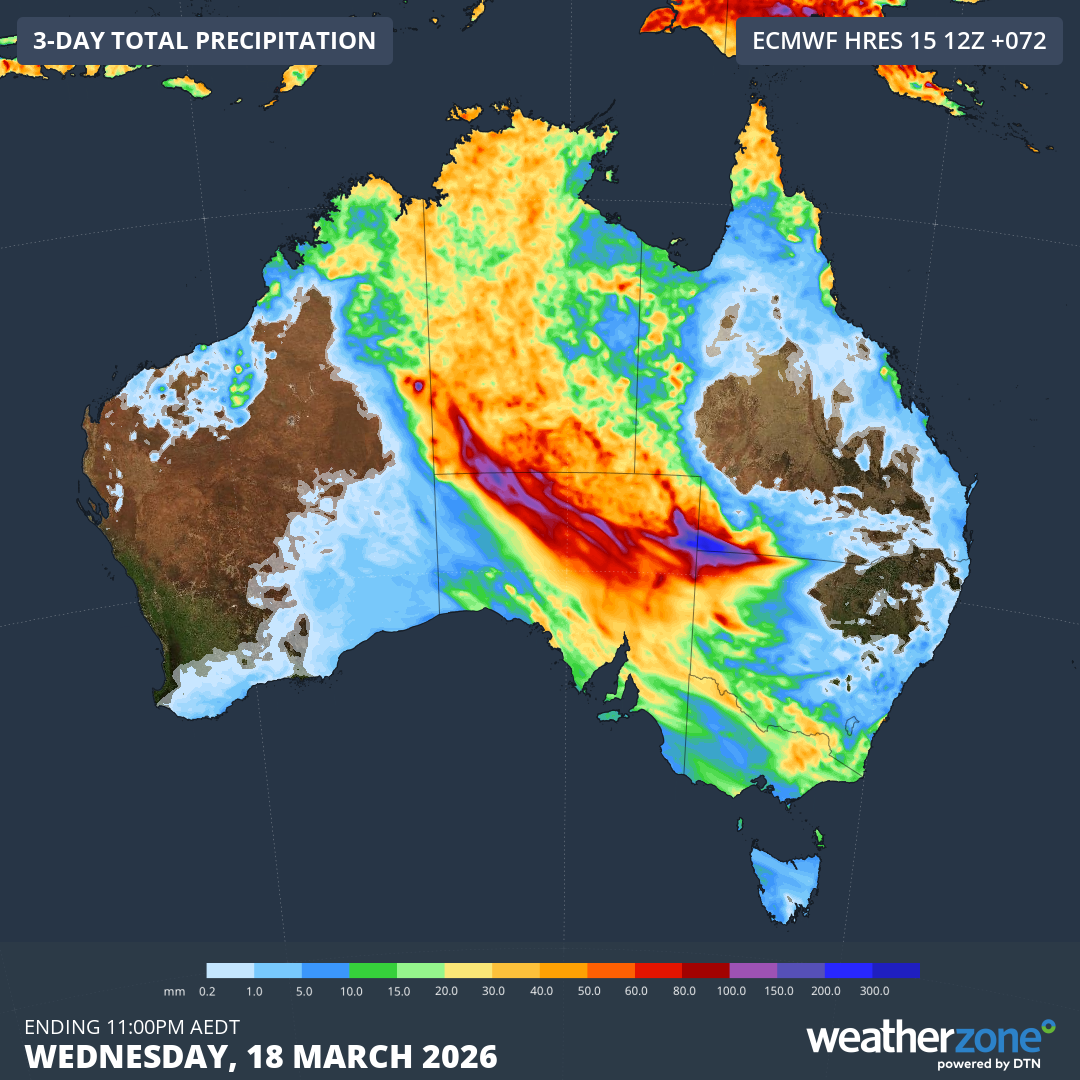
Image: Forecast accumulated rain during the 72 hours ending at 11pm AEDT on Wednesday, March 18, 2026. Source: Weatherzone.
As of midday ACST on Monday, a severe weather warning was in place for heavy rain and flash flooding in parts of the NT’s south and southwest, including the Uluru region.
Another warning was also in place for heavy, locally intense rain in the north of SA. This warning mentioned the risk of “dangerous and life-threatening flash flooding” from potential rain rates of 80 to 120 mm in six hours, most likely north of Marree during Monday night into Tuesday morning.
Further severe weather warnings and flood warnings may be issued over central Australia during the next few days as ongoing heavy rain and thunderstorms continue to affect parts of the NT, SA, Qld and NSW.