
Twin hurricanes dancing over North Atlantic Ocean
Satellites have captured a rare display of two hurricanes interacting over the North Atlantic Ocean, engaging in a phenomenon known as the Fujiwhara effect.
What happens when two hurricanes get close to each other?
While any sort of cyclone can merge with another to form a larger or more intense system, they can also find a balance point around which they perform a rotational dance and have an impact on each other’s paths. This binary interaction around a common point is called the Fujiwhara effect.
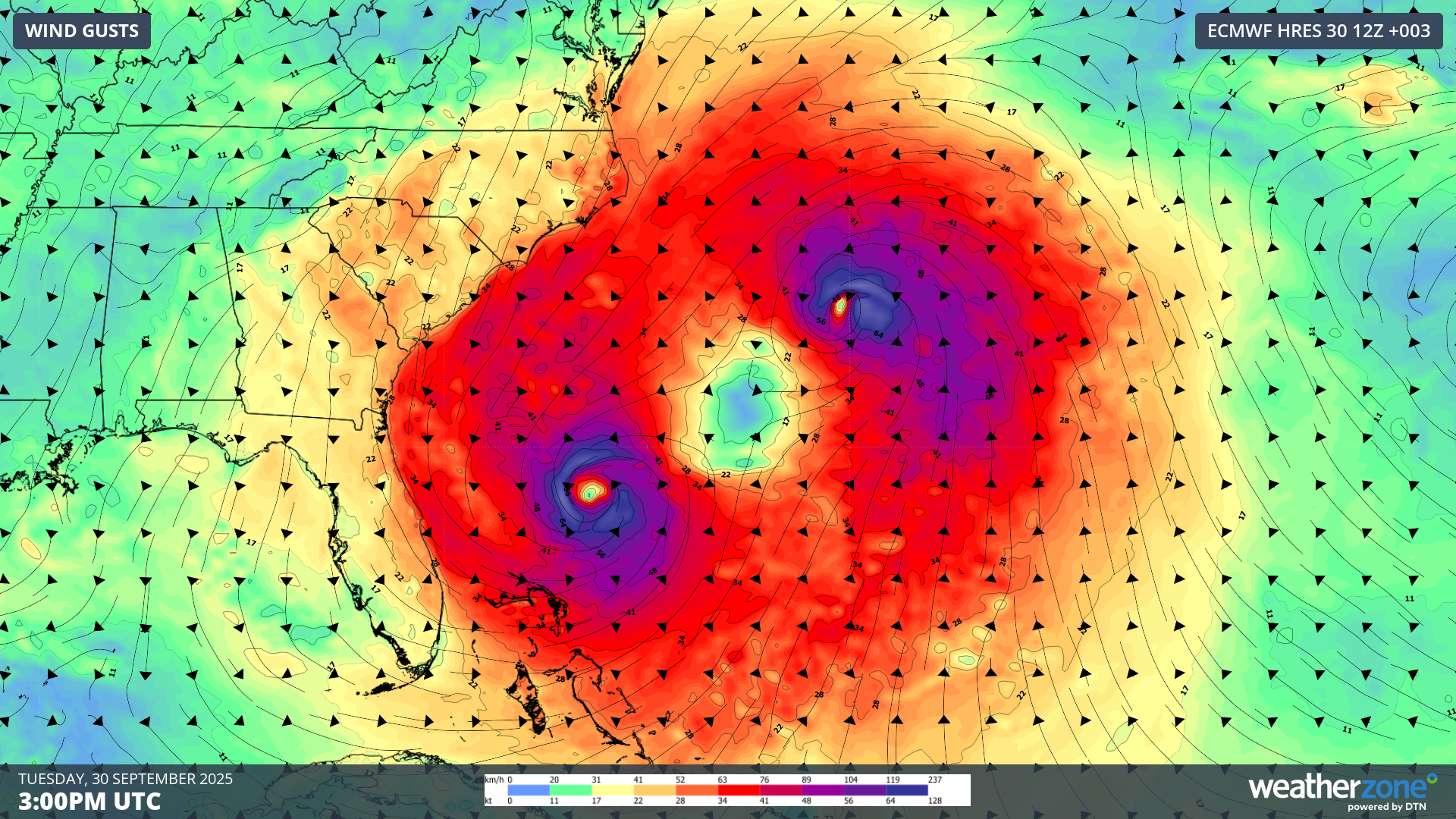
Image: Modelled wind gusts around Hurricanes Humberto and Imelda.
Humberto and Imelda
The recent proximity of Hurricane Humberto and Hurricane Imelda provides a rare illustration – the Fujiwhara effect is seen only a couple of times per decade in the northern Atlantic, although a bit more frequently with typhoons in the Pacific as tropical storms are more common there, and often closely packed.
Video: Humberto and Imelda dancing off the U.S. East Coast on Tuesday, September 30, 2025. Source: CIRA / GOES-19
Humberto became a hurricane on September 26, 2025, rapidly intensifying to a Category 5 storm on the 27th, south-southeast of Bermuda. It subsequently turned sluggishly to the north prior to a further veer northeastward and an escape across the North Atlantic while steadily weakening.
Meanwhile, Tropical Depression Nine was developing on the 27th, near Hispaniola. It turned northward and became Tropical Storm Imelda on the 29th, then strengthened to a hurricane the following morning.
Up until that point, there was a fear that Imelda could surge northwards towards the Carolinas, but an equal chance that it could come under the influence of Humberto, with the centers of the two storms closing to less than 600 miles apart.
Imelda tugged on Humberto a little and slowed it, while the larger Humberto did indeed drag Imelda sharply east-northeastward, like a gravitational pull, to the relief of the Southeast and Mid-Atlantic. If it had stalled near the coast, then major flooding could have resulted.
While Humberto will race ahead of Imelda, in more classical examples the Fujiwhara effect can have a more balletic result. Two storms may pirouette around each other, especially if they are of a similar size, in the same direction as the winds flowing around them at the surface: that is to say, counterclockwise in the northern hemisphere. Eventually one of them will weaken, they will merge or they will each go their own separate way. In any case, the result is often unusual and rather unpredictable storm tracks which models can struggle to resolve.
Humberto and Iris, 1995
Another example of the Fujiwhara effect involved another Hurricane Humberto 30 years ago, in August 1995. It found itself in the vicinity of the next tropical cyclone, which became Hurricane Iris, and the two performed a slow rotation around a shared axis near the Lesser Antilles, tugging on and temporarily disrupting each other’s structures, with Humberto weakening and eventually getting swallowed up by an extra-tropical system west of the Azores.
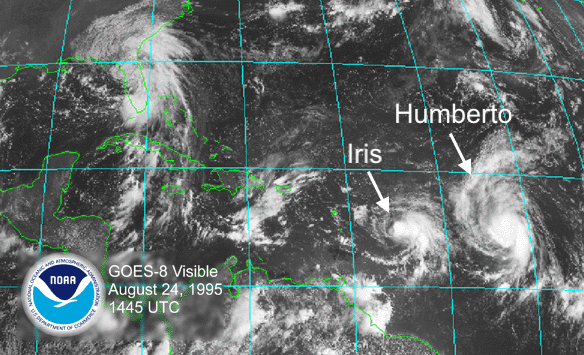
Image: Iris and Humberto in close proximity on August 24, 1995. Source: NOAA
The Fujiwhara effect
The Fujiwhara effect was first proposed in 1921 by the Japanese meteorologist Sakuhei Fujiwhara, who realized that when two tropical cyclones are within 900 miles of each other, their circulations can interact, forcing them to orbit around the balance point between them. For extra-tropical cyclones, the distance can be up to about 1200 miles.
These interactions can be complex and finely balanced, with the resulting motions depending on the relative sizes of the cyclones involved, the size of the gap between them and surrounding atmospheric conditions. Oceanic temperatures, atmospheric pressure and wind shear all have a part to play, and each parameter can be influenced by either of the storms involved.
If the systems merge, then a more intense storm may result, or one or other of them may slow or even halt, leading to extended periods of heavy rain and risks of widespread major flooding. Alternatively, uncertain directions and landfalls may occur, making disaster preparations uncertain.
The Fujiwhara effect can be a meteorological migraine but can also, as we have just seen, have a beneficial result.