
The Five Year El Niño of 1788–1793
Towards the end of the 18th century, a prolonged and intense El Niño disrupted temperature and rainfall patterns across the world, causing monsoon failure and severe drought. Now, more than 230 years later, El Niño is once again underway in the Pacific.
Strong Pacific warm-up underway
El Niño has developed in the tropical Pacific. Sea surface temperatures recently warmed past the El Nino threshold and are expected to steadily rise through the Northern Hemisphere’s summer.
By fall, most models are showing that we will be in the realms of a “Super El Niño”, meaning the central and eastern Pacific reaching at least 2°C above average. There’s even a chance of reaching or exceeding a 3°C anomaly in this region. This massive warming will affect and alter weather patterns worldwide.
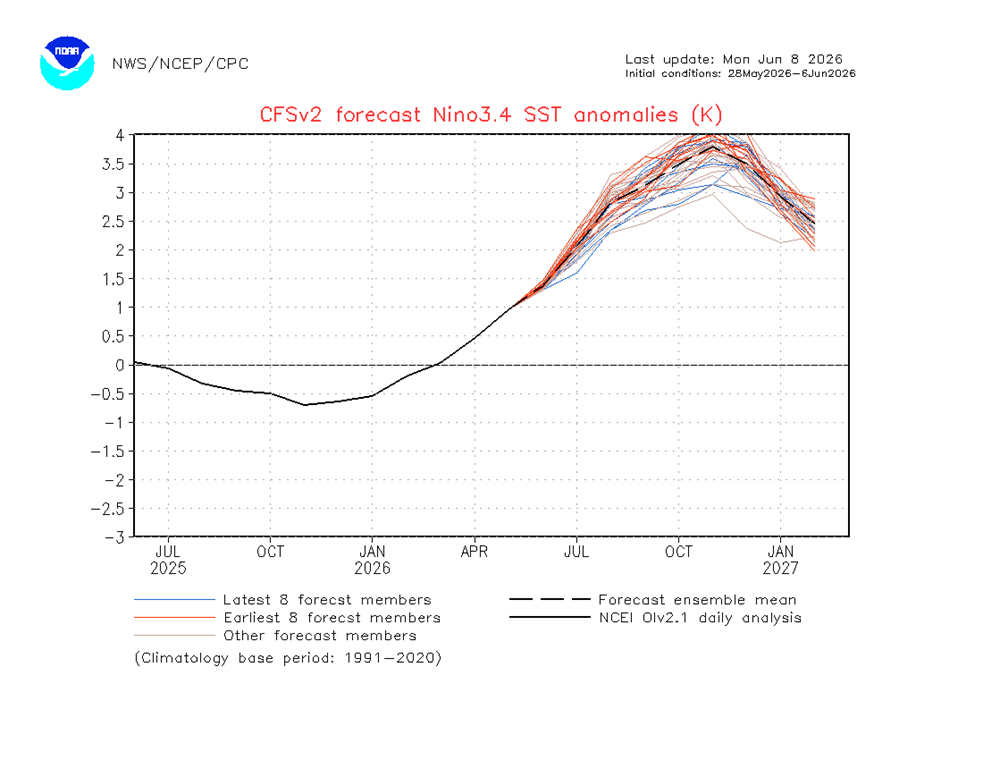
Image: Niño3.4 sea surface temperature anomaly forecast. Source: NOAA.
Super El Niño events in the last half century include 2015-16, 1997-98 and 1982-83. But looking back more than 200 years, the most intense and long-lasting episode that climatologists have identified occurred between 1788 and 1793. Five years of El Niño had a notable impact, as described in many contemporary accounts and diaries.
Proxy Observations
In the absence of satellite data and extensive observations, like ocean buoy arrays, evidence for this El Niño comes from ship observations and, indirectly, tree rings, ice cores and coral reefs.
In areas like the Pacific Northwest, tree rings from that period had narrow rings, indicative of a lack of rainfall, while ice cores from the Quelccaya ice cap in Peru revealed much less snowfall and more dust deposits than usual. Oxygen isotope analysis of Pacific corals also points to significant warming of the ocean.
Impacts on the USA
The population was, of course, sparse in the late 18th century, and instrumentation more so, and concentrated largely in the east. As a result, much of the USA lacks detailed climatological records.
Nevertheless, some conclusions can be drawn from the limited evidence we do have. For example, consistent with what we know about El Niño’s impacts, the Northeast had mostly mild or even warm winters, with a shifted jet stream tending to hold Arctic outbreaks at bay.
1789-90 has been dubbed “the year without a winter” in the Northeast. In prior years, the Delaware river froze over, but the water was left ice-free that winter, and was evidently warm enough for people to swim in it during January. That’s according to the diary of the weather observer and Philadelphian Charles Peirce, who also noted daytime highs of 70 degrees F.
January as a whole was 12 degrees above the climatological average, and he also noted April blossoms appearing in June, along with all sorts of early vegetation growth. This became a huge agricultural problem, when a late hard frost in early spring devastated many crops.
Other winters during this five-year stretch were more variable but still had more mild weather than cold, although the late winter and early spring of 1789 were very cold, as was December 1790. The winter of 1792-93 was mild and followed by an exceptionally hot and humid summer.
The mild and often humid conditions near the East Coast may have been partly responsible for the yellow fever outbreak in 1793, due to greater survival rates of mosquito larvae. The following hot and wet summer made for ideal breeding conditions.
Other areas exhibited classic El Niño conditions during this period: it appears to have been largely wetter than normal from Texas across the Gulf Coast to the Southeast, where storm systems were more frequent. On the other hand, a scattering of reports indicate that farming difficulties arose from dry conditions around the Great Lakes, Ohio Valley and interior Mid-Atlantic – a distinct threat to the overwhelmingly agricultural new nation.
Worldwide impacts
Globally, there is more evidence. The ‘mega’ El Niño in the late 18th century caused monsoon failure and severe drought in India, with the dry conditions responsible for the Doji Bara famine of 1791-92, which caused the deaths of an estimated 11 million people.
It also coincided with the early British colonization of Australia, where a multi-year drought caused crop failure and the near starvation of the colony around Sydney Cove.
Europe was affected as well, and El Niño was perhaps at least partly responsible for accelerating the French Revolution. Erratic weather and periods of drought, especially in the summer of 1788, disturbed the growing seasons, leading to crop failures, rapid inflation and bread shortages, which were catalysts for the storming of the Bastille on July 14, 1789.