
Soggy March with coolest Australian maximums since 2012
Australia has experienced one of its increasingly rare cool temperature anomalies in March 2026, with below-average nationwide maximums which were the coolest since 2012.
But minimum temperatures nationwide were much warmer than usual, meaning that Australia’s overall temperature in March was still well above the long-term average.
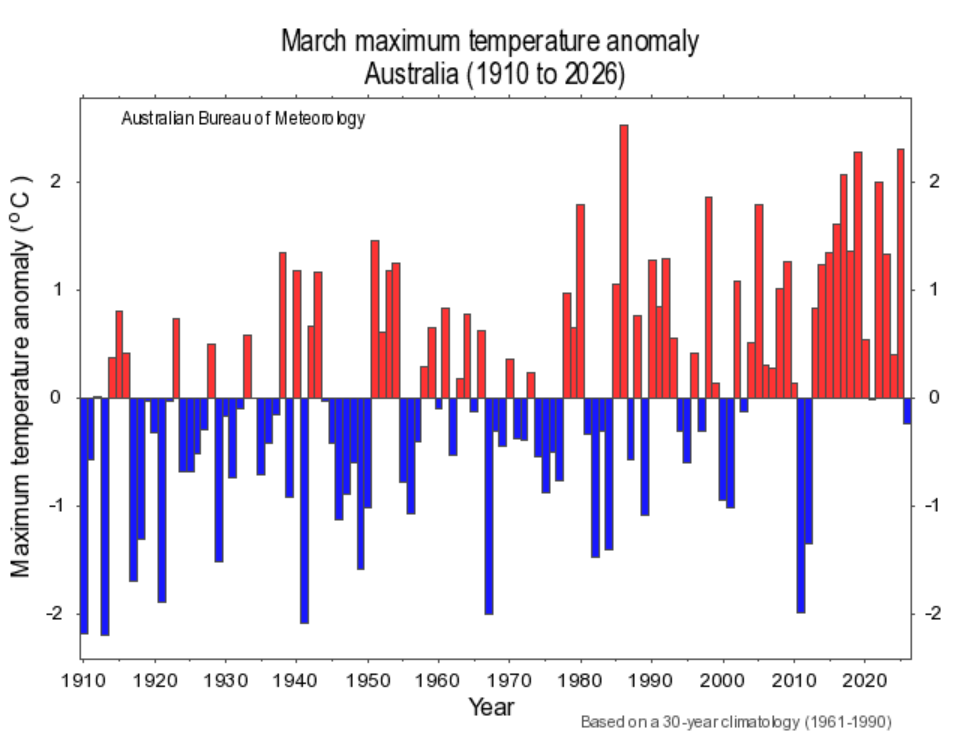
Image: Historical March maximum temperature anomalies in Australia since 1910. Source: BoM.
Average Australian temperatures in March 2026:
- Maximum temperatures across Australia were 0.24°C below the long-term average
- Minimum temperatures across Australia were exactly 1°C above the long-term average
- The national area-averaged mean temperature (the combination of daytime and night time readings) was 0.38 °C above the long-term average.
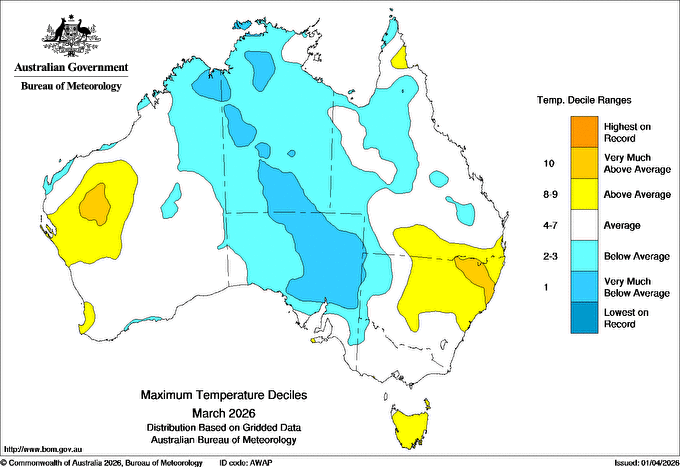
Image: Maximum temperature deciles in Australia in March 2026. Source: BoM.

Australian rainfall in March 2026
This year saw the 8th-wettest March since nationwide records were first collated in 1900, with 69% more rain than the long-term average, and above-average rainfall in all states and territories except Tasmania.
As you can see on the map below, only a large chunk of northeast NSW and adjacent parts of Queensland were significantly drier than usual. Most of the mainland was much wetter than average, including large parts of the outback.
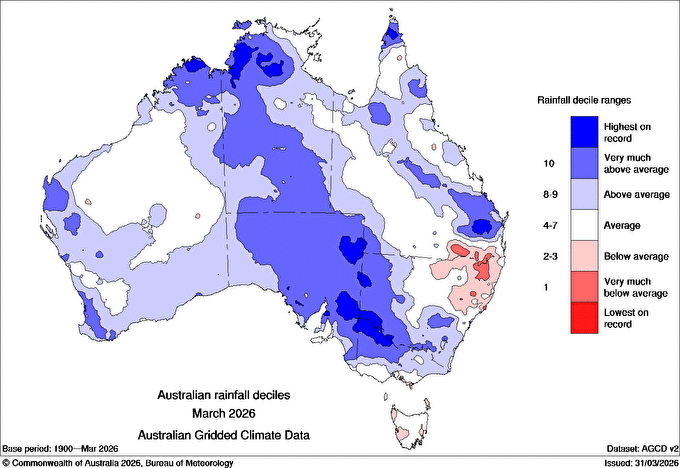
Image: Australian rainfall deciles in March 2026. Source: BoM.

Rainfall was the highest on record for parts of the NT’s Top End, Qld’s Wide Bay and Burnett district and Cape York Peninsula, and eastern SA and adjoining areas in western NSW and Victoria.
For South Australia as a whole, it was the 2nd-wettest March on record.
How rainy weather made days cooler and nights warmer
There’s a strong and fairly obvious correlation between Australia’s relatively cool maximums in March 2026 and the abundant rainfall in most parts of the nation.
Cloudy skies usually tend to knock off a few degrees during the day, which explains the relatively cool daytime temperatures.
There was also a correlation between the above-average rainfall and the warm minimums Australia experienced in March. Clouds act as a blanket at night, absorbing heat radiated from the Earth’s surface and preventing it from escaping upwards.
Meanwhile, Australia’s hottest temperature in March 2026 was 44.6°C at Mount Magnet in WA, while Perisher Valley in NSW fell to -3.4°C.