
Melbourne’s coldest night of 2026 as five states fall below zero
Frigid temperatures were recorded overnight across southeastern Australia, as dry, cold air settled over the most heavily populated corner of the country in the wake of a cold front.
Let’s whip around the southeastern states to see how low the mercury fell on Monday morning:
Victoria
- Melbourne recorded its coldest night of the year with a low of 3.2°C at the main city weather station, while the airport plummeted to just 0.1°C – also its coldest night so far this year.
- Coldstream, in the Yarra Valley on the far northeastern outskirts of the city, an hour from the CBD, fell to -2.7°C – its coldest night of the year by almost two degrees.
- Mt Hotham Airport (elevation 1295 m) was the chilliest place in the state with a low of -4.6°C. This was its coldest night of 2026 to date.
Tasmania
- The tiny town of Liawenee, at an elevation of 1057 m on Tasmania’s Central Plateau, shivered through a minimum of -8.1°C. This was Australia’s lowest temperature of July 2026 to date, although it’s worth noting that the town saw three colder nights in June.
- Hobart had a low of just 2.6°C, its coldest night of July 2026 to date.
- Ouse, in the Upper Derwent Valley, had its most frigid night in almost two years with a low of -5.5°C.
South Australia
- You usually look to the southeast of SA to find the state’s coldest minimums in winter, but Yunta, in the North East Pastoral forecast district was officially the chilliest spot overnight with a low of -1.7°C.
- The coldest place in the state’s southeast was the famous wine area of Coonawarra, which fell to -0.3°C.
New South Wales
- As you’d expect, the coldest spot was in the Snowy Mountains, where Perisher Valley fell to –5.6°C. That was good news for the snowmakers, who were able to augment the snowpack by firing up the snow guns after around 30 cm of natural snow fell on Friday.
- Sometimes in winter, the Northern Tablelands register the coldest NSW nights. In 2023, Glen Innes had Australia’s coldest temperature with a low of –10.8°C. But the influence of moist easterly winds over the state’s northeast prevented subzero minimums this Monday.
ACT
- The minimum stayed a few degrees above zero in Canberra and its suburbs due to the flow of moist winds from the southeast (even though just 0.2mm of rain was recorded at Canberra Airport).
- It was a different story up in the Brindabella Ranges west of the city, where Mt Ginini stayed dry and registered an overnight minimum of –2.6°C.
Why was it so cold overnight?
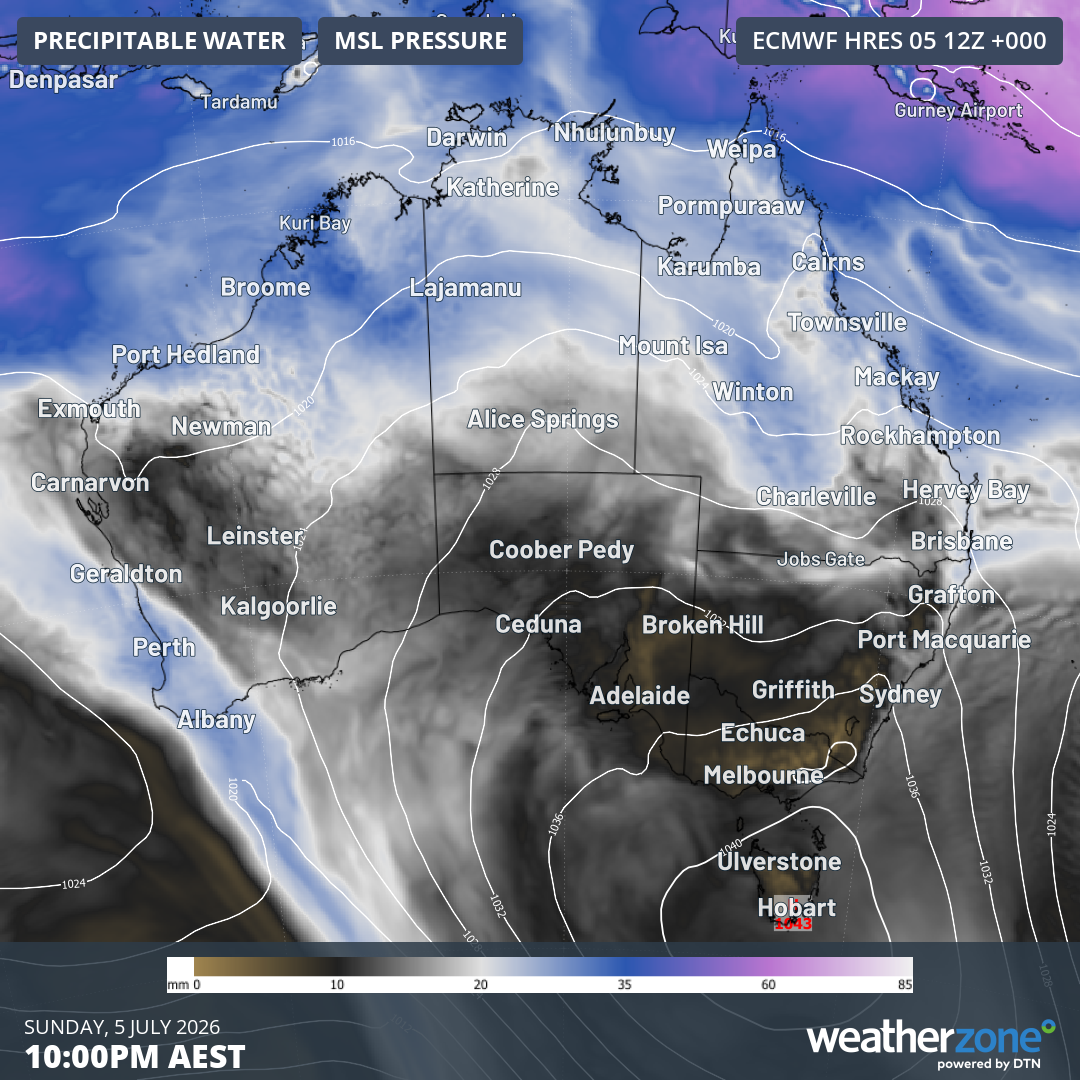
Image: Precipitable water and mean sea level pressure over Australia at 10 pm (AEST) on Sunday, July 5, 2026. Source: Weatherzone.
As the map above shows, a strong high pressure system centred over Tasmania caused stable conditions which were perfect for low minimums given the existing cool airmass over most parts of southeastern Australia.
Only the east coast and some nearby ranges escaped the worst of the chill, due to the onshore flow from the Tasman Sea.
Further chilly nights can be expected for at least the first half of the working week across most of the areas mentioned.