
Ice is slippery. Explaining why has stumped scientists for over a century
The Winter Olympics are over; the results are all in. But one question remains: why is ice slippery?
Without that fundamental property, many winter sport disciplines, like ice hockey, speed skating, curling and luge, would not exist; but the exact reason for it has been debated for a couple of hundred years.
Under pressure
It’s taken for granted that when we step on ice we can slide uncontrollably, or with measure of control if we’ve strapped on a pair of skates. An early proposal, from the 19th century, was that the pressure exerted on ice might be sufficient to partially melt it and produce a very thin layer of lubricating water.
A British engineer called James Thomson first posited that pressure lowers the melting point of water below the usual 32 degrees Fahrenheit, and this was confirmed through experimentation by his brother William Thomson – later Lord Kelvin, who lent his name to the SI unit of temperature.
Friction
However, in the 1930s, research out of the University of Cambridge revealed that the pressure required would have to come from thousands of pounds more weight than the average human.
Instead, Frank Bowden and T.P. Hughes suggested that it was friction rather than pressure that raised sufficient warmth to melt the ice, and to try to prove it closeted themselves in an artificial Alpine ice cave, the Jungfraujoch Ice Palace. They concluded that materials that were poor conductors of heat provided less friction, while good conductors, like certain metals, had the opposite effect.
Non-friction
This is not universally accepted, though. Other researchers have pointed out that ice melts following the application of friction, whereas ice is slippery at the very moment it’s stepped upon. Experiments conducted at the University of Amsterdam showed that increasing the speed of the frictional object made no difference to the slipperiness of ice.
Pre-melt
Is it possible, therefore, that ice has a surface layer, just a few molecules thick, that is already partially melted, or very close to that state? A clue to this was first spotted back in the mid-19th century by Michael Faraday, who noticed that two touching ice cubes would freeze to one another. Maybe exposed ice surfaces melt a little, then re-freeze when covered up?
It was another hundred years before scientists proposed an explanatory theory: within ice cubes, molecules are held in a lattice by all their neighbors; but each molecule at the surface has fewer others with which to bond and can be more readily displaced.
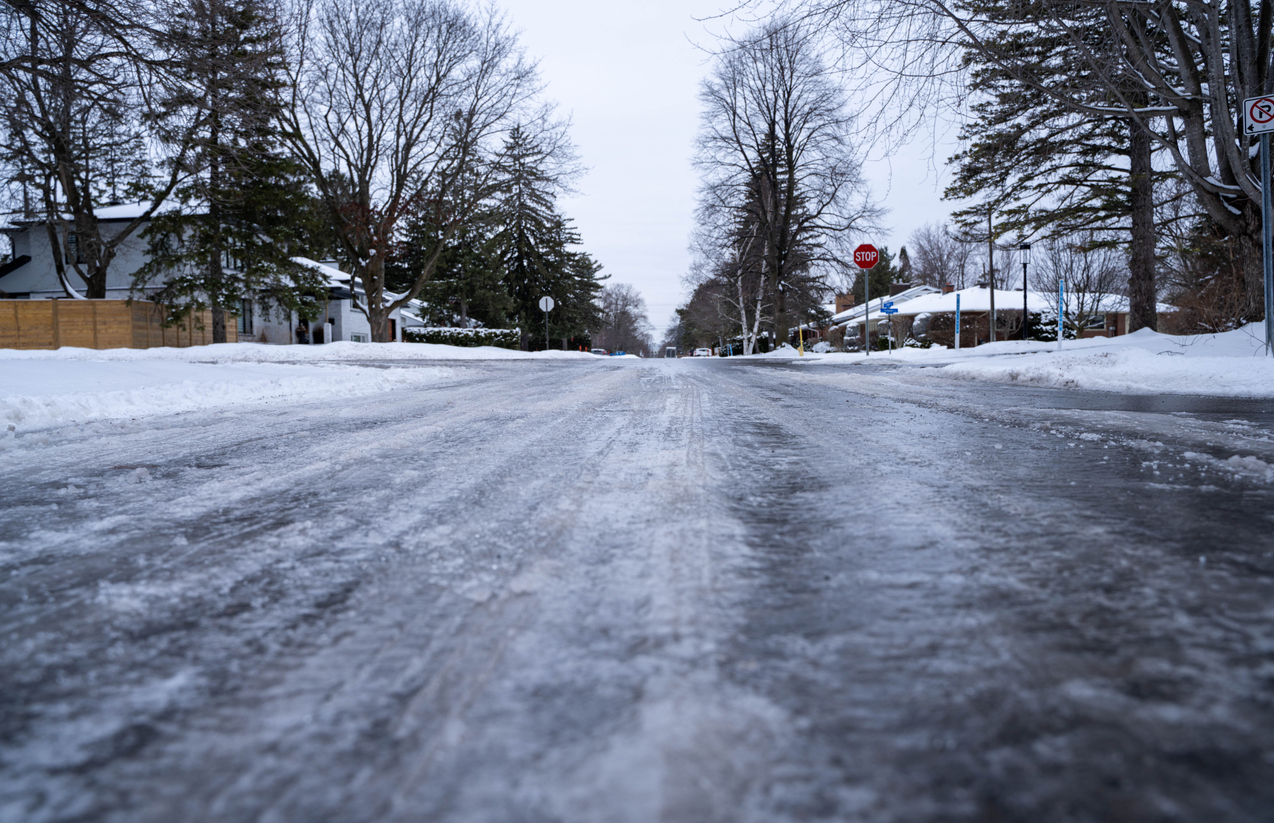
Image: Slipperly ice on roads can make it dangerous to drive. Source: iStock / redtea.
Simulations
More recently, researchers at the University of Madrid used computer modeling to try to settle the matter but perhaps made it more confusing when their simulations suggested that pressure, friction and pre-melting all had a role to play. A pre-melted layer seems to exist but it also thickens under pressure. Furthermore, at low enough temperatures friction can cause the layer to thicken as well.
However, other researchers at Germany’s Saarland University argued that the frictional heat generated by, say, a skate would be insufficient, and that the point of contact would need to be unfeasibly small for sufficient pressure for melting. They also discovered that ice is still slippery even at very low temperatures when there is no possibility of a pre-melted layer.
‘Amorphization’
Via further experimentation with computer-simulated diamonds, they discovered surface atoms were pulled out of their bonds, creating an ‘amorphous’ layer. With simulations of ice sliding against ice, there was initial attraction between the surfaces which got broken and reformed as sliding proceeded, leading to a change in molecular structure.
When ice was replaced with other materials in the simulations – materials that either attracted or repelled – there were similar results, with more disruption when the substance and the ice were attracted.
They concluded that this disordered amorphous layer was more likely to be responsible for slipperiness than melting. So we are probably getting closer to a full explanation; but in any case, until winter is over, watch your step out there – or strap on a pair of skates.