
How does weather affect baseball?
The weather doesn’t just set the scene at the ballpark – it can completely change the game.
The transition from winter into the warmer months of the year can feature some volatile conditions across North America as advancing warmth clashes with the lingering cold of winter, energizing the jet stream.
We’ve seen that in recent weeks, with severe storms and tornadoes, snow and a switchback of temperatures.
Rain and storms
As most games are played outside, they can be hostage to the weather, and tarps might need to be unfurled at a moment’s notice. Even then, persistent or particularly heavy rain, or the threat of lightning, can lead to postponements or force teams into double-headers. Play is suspended if lightning is dictated within 6 to 8 miles of a stadium, and there has to be a 20 or 30-minute wait once a storm has cleared for the game to resume.
At the very least, teams and analysts lean on weather data and forecasts to consider how conditions might impact hitting and pitching.
Only one Major League stadium is fully enclosed: the newly repaired Tropicana Field in St. Petersburg, FL, which was wrecked by Hurricane Milton in October 2024 – a rather extreme weather impact. Seven have retractable roofs, which are often open in fine weather but need a heads-up to close ahead of approaching rainstorms.
Wind
Strong winds have the most obvious effect, sometimes turning fly balls into home runs, or causing the ball to drop short into an outfielder’s mitt if hitting against it. Wrigley Field in Chicago is a prime example of a ballpark where tactics are often dictated by the wind direction and strength.
Summer heat
Heat and humidity have a less visible bearing, but high humidity can also lead to a greater chance of going deep. Counter-intuitively, perhaps, hot or humid air masses are less dense than dry and cool air, although humid air may feel ‘thicker’.
At the same pressure and temperature, the number of molecules in a given volume is always constant. When humidity increases, some oxygen and nitrogen molecules are kicked out of this volume and replaced with water, which has a lower molecular weight. This results in a lower overall mass in the volume, and therefore lower density, which can add 20 or 30 feet to a hard-hit ball.
It’s not a coincidence that there are, on average, fewer home runs launched early and late in the MLB season, while the frequency of dingers peaks in August.
Early-season snow risks
Pre-season usually has few weather issues, being played in the usually fine and warm weather of an Arizona and Florida spring. Having said that, teams encamped in Arizona this year had to contend with some unusually early high heat. Of course, heat can become a problem anywhere in the US through the summer, needing careful hydration for players and fans, and sometimes cooling measures in the dugouts.
At the other extreme, once the season gets underway there can be risks of cold and snow at the more northern stadia in March and April.
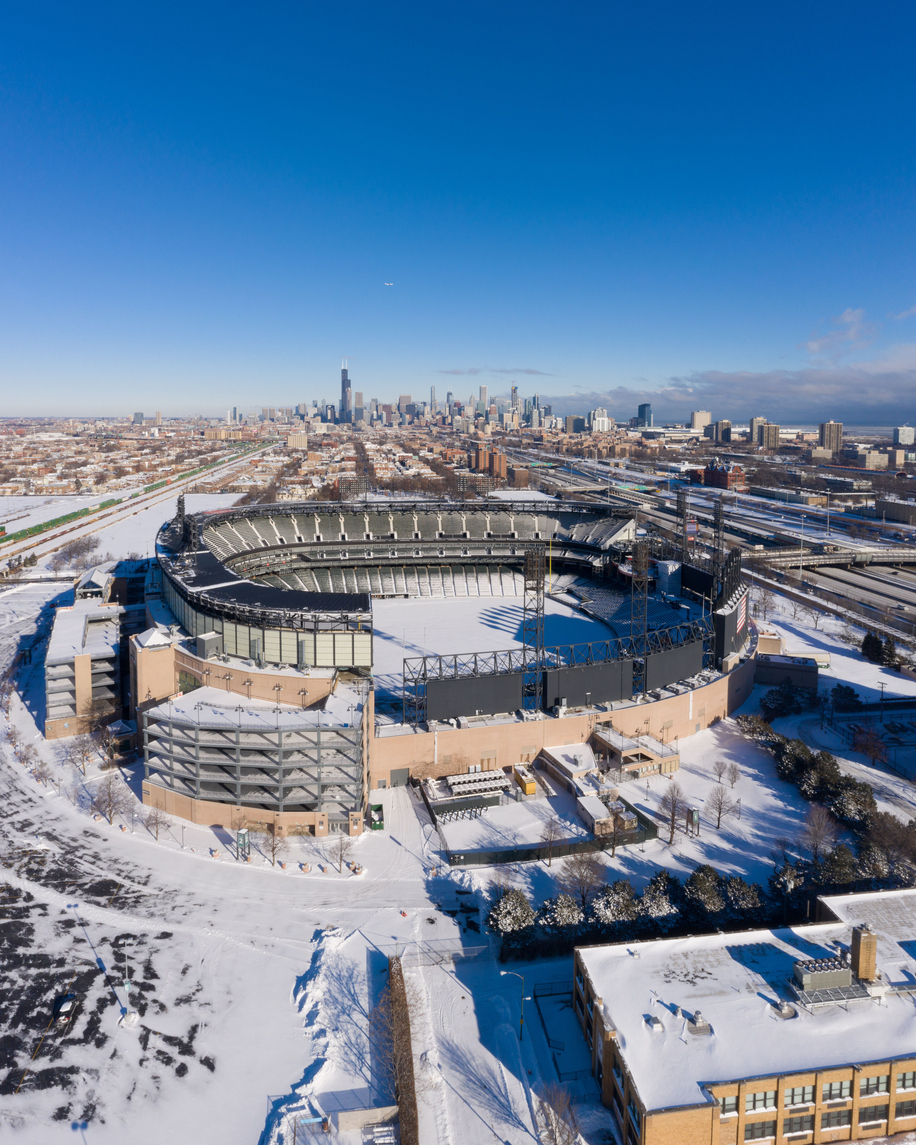
Image: Snow at Rate Field (formerly Guaranteed Rate Field), Chicago in January 2022. Source: iStock / Wirestock.
Games can take place if snow is not too heavy; but a full-on snowstorm in 1907 caused the abandonment of a game between the New York Giants and the Philadelphia Phillies, after a snowball melee broke out between fans, and the home plate umpire caught a stray.
In 1972, the Brewers borrowed a helicopter to clear snow from the bleachers, while in 1953, Boston Red Sox pitcher Mel Parnell shuffled to the mound on skis and tossed snowballs. History is silent on whether he was throwing strikes.