
Heat records tumble under European heat dome
A widespread heatwave with exceptionally high temperatures broke records across Western and Central Europe last week. Several countries broke their June temperature records, and a few even set new all-time records. This unusually warm weather was caused by a so-called heat dome.
What is a heat dome?
A heat dome is a large high pressure system filled with warm air that can persist for days or even weeks. The high pressure forces warm air downward, and as the air compresses, it warms even further, trapping the heat beneath it.
The near-stationary high pressure systems that cause heat domes often result in prolonged periods of very warm, calm and dry weather. Developing drought can also intensify the heat further.
A notable example of a heat dome occurred over western North America in June/July 2021. It produced a temperature of 49.6°C in the village of Lytton in western Canada, setting a new all-time national temperature record.
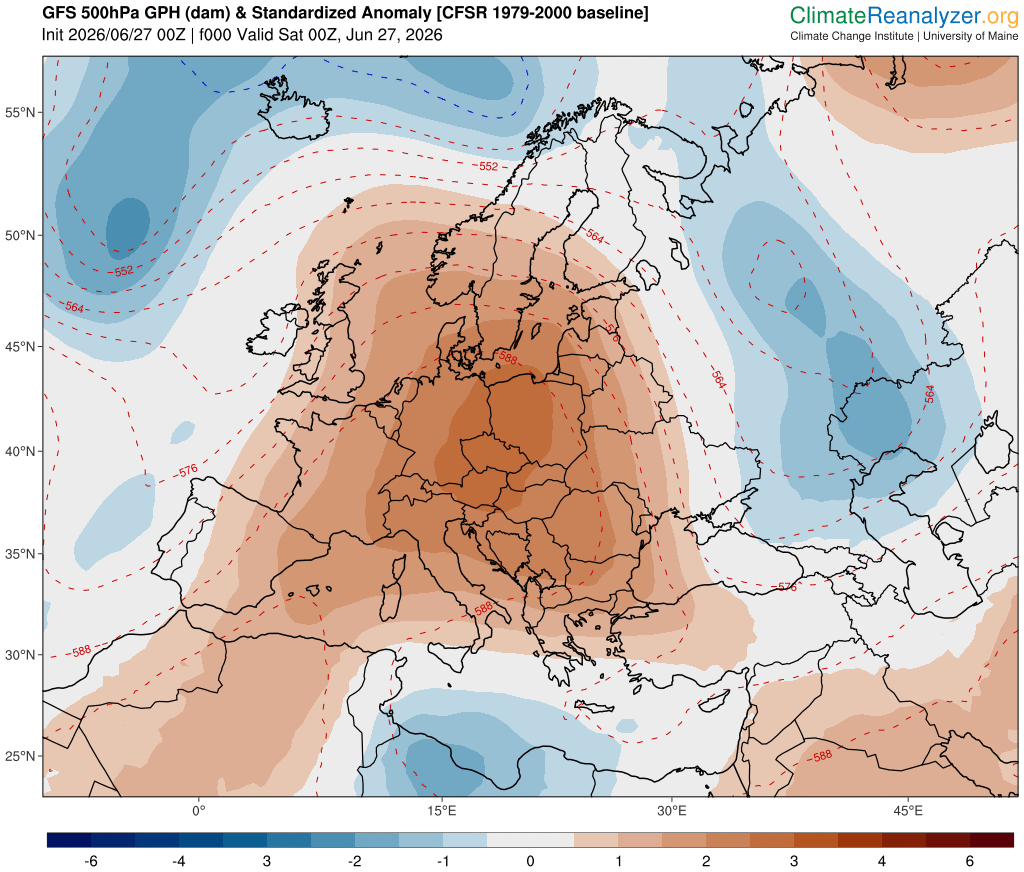
Image: Map of 500 hPA geopotential height anomaly on Saturday, June 27, 2026. Red indicates a positive anomaly, showing the heat dome over Europe. Source: ClimateReanalyzer.org
Records broken across Europe
During this month’s heatwave in Europe, warm air originating in North Africa became trapped beneath a heat dome over Western Europe.
Central and southern parts of France saw temperatures well above 40°C on successive days, with 44.3°C recorded in Pissos (Landes) as the highest temperature Tuesday last week.
In the United Kingdom, a high of 37.7°C was measured on Friday at Lingwood, Norfolk, provisionally setting a new June temperature record for the country. It was also the third day in a row that a new provisional June record was set in the UK.
Belgium also set a new June record last week, with a maximum temperature of 39.9°C, while the Netherlands exceeded its previous June record from 1947 by reaching 39.4°C.
Also worth mentioning are the exceptionally high minimum temperatures from this heatwave: multiple countries experienced a series of nights during which the temperature did not fall below 20°C, and in some places not even below 25°C.
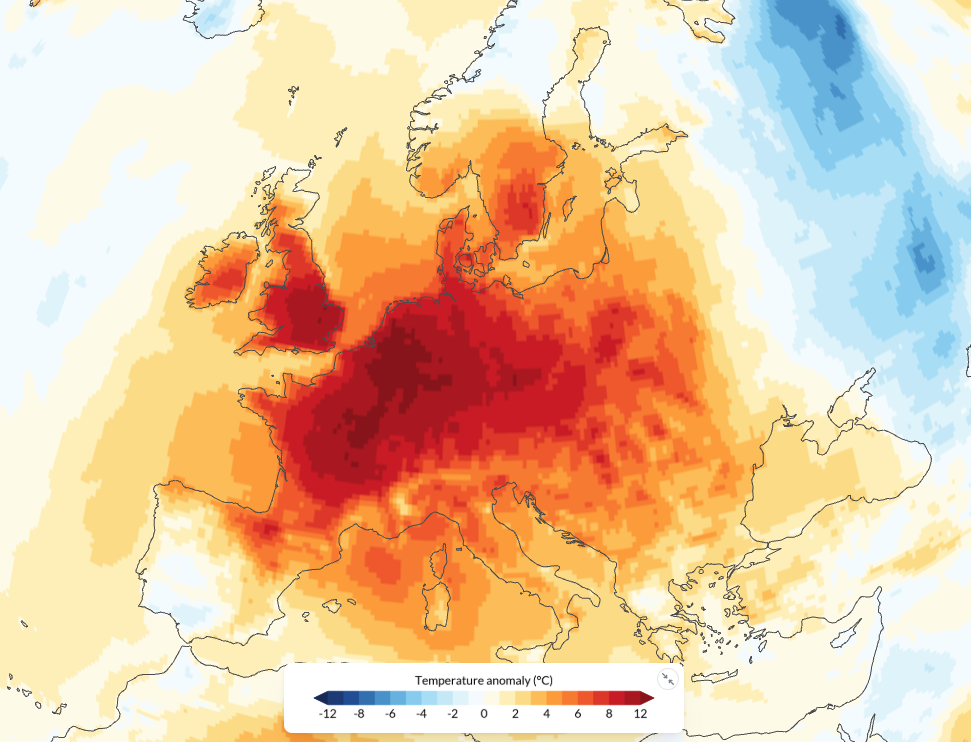
Image: Map of temperature anomaly on Friday, June 26, 2026. Temperatures were more than 10 degrees above normal for much of western Europe. Source: Copernicus Climate Pulse.
By the end of last week, the heat dome and its extremely warm conditions had shifted eastward, causing more records to be broken in Central Europe.
In Germany, the national temperature record was broken on multiple consecutive days. Last Sunday, June 28, a temperature of 41.7°C was measured in Neißemünde, Brandenburg, making it the warmest day on record in the country. Germany also recorded its warmest night ever, with a minimum temperature of 29.4°C in Kubschütz, Saxony.
Denmark set a new all-time record with a temperature of 37.0°C on Saturday, June 27. Poland and the Czech Republic also established new all-time records, with maximum temperatures of 40.5°C and 41.9°C, respectively.
More heat on the horizon
While a westerly breeze is bringing cooler conditions to parts of Europe this week, this is unlikely to be the last heatwave of the summer. Indeed, indications are that another spell of hot weather may develop as soon as next week.
Due to climate change, heatwaves are expected to become more frequent and more intense. As temperatures continue to rise, heat dome events like the one experienced last week are likely to produce even higher temperatures and have greater impacts than in the past.