
Europe enthralled by total solar eclipse
On August 12, many parts of Western Europe will witness a solar eclipse. Iceland and Spain (and a small fraction of Portugal) will experience the magic of totality, while other countries in Western Europe will see a partial eclipse.
Shadow of the Moon – What is a solar eclipse?
A solar eclipse occurs when the Moon passes between the Sun and Earth, temporarily blocking the Sun's light from reaching parts of Earth’s surface. This can only happen during a new moon, when the Sun, Moon and Earth are roughly aligned. When the alignment is just right, the Moon casts its shadow onto Earth's surface.
The darkest part of this shadow creates a narrow path where a total solar eclipse can be seen. Surrounding this is a much larger area of partial shadow where only part of the Sun is obscured. Because the Moon's shadow covers only a small area of Earth's surface, total solar eclipses are rare at any particular location. This is why some places can go for decades, or even much longer, without experiencing a total solar eclipse.
Path of the eclipse
The total eclipse on August 12 will first be visible in northern Russia before the Moon's shadow moves across Greenland and Iceland. In Iceland, totality will occur during the late afternoon. In Reykjavík, the partial eclipse will begin at 16:47 GMT, with totality starting at 17:48 GMT and lasting for just over one minute. The partial eclipse will end at 18:47 GMT.
The eclipse will then continue across the North Atlantic towards the Iberian Peninsula. In northern Spain, totality will occur in the late evening, shortly before sunset. The total eclipse will also briefly reach a small area in northeastern Portugal. The timing and duration of totality will vary along the path. For most locations, totality will last less than two minutes, while the maximum duration along the centre of the path will be approximately 2 minutes and 18 seconds.
Elsewhere in Western Europe, the eclipse will be partial. The British Isles, France, the Benelux countries, Portugal, Switzerland, and parts of Germany, Austria and Italy will see more than 90% of the Sun covered.
It is important to note that it is not safe to look directly at a partial solar eclipse without eye protection. According to NASA, “except during the brief total phase of a total solar eclipse, when the Moon completely blocks the Sun’s bright face, it is not safe to look directly at the Sun without specialized eye protection for solar viewing.”
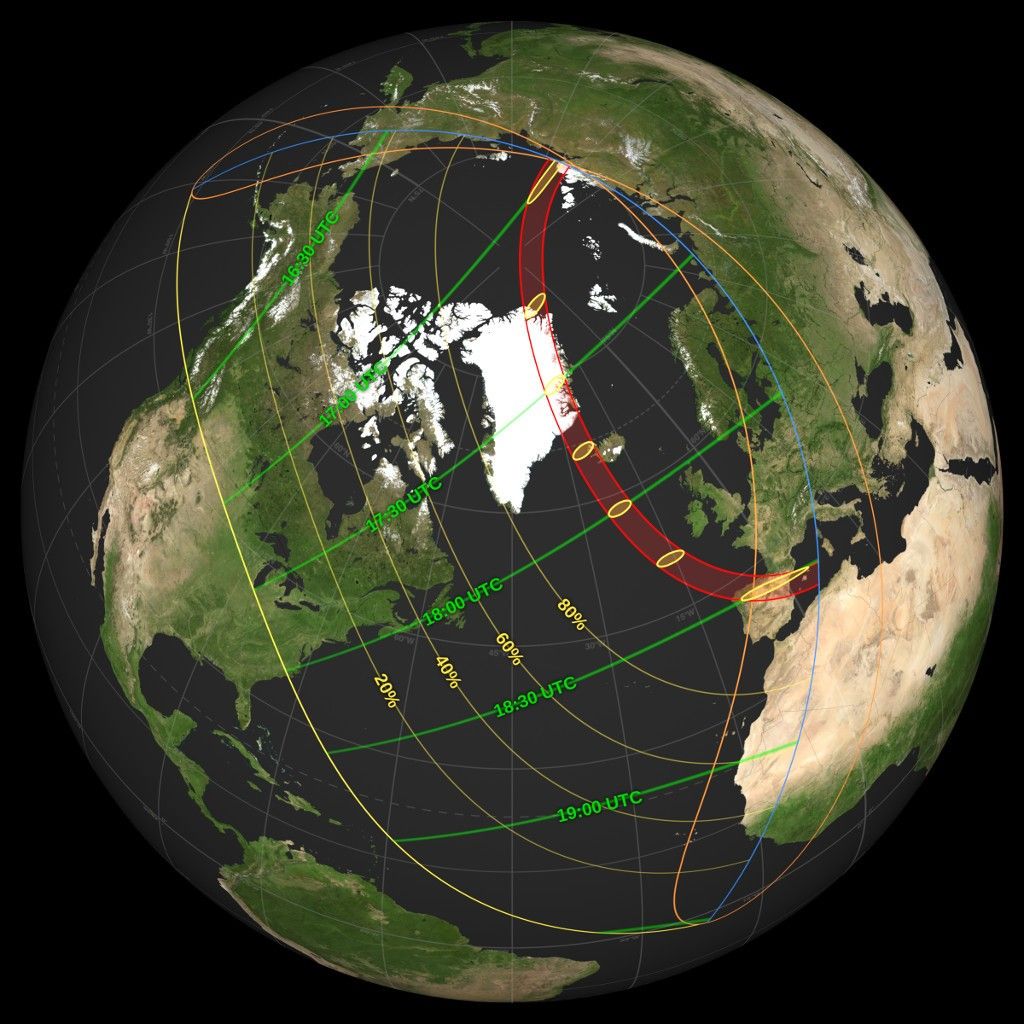
Image: The path of the eclipse of August 12, 2026. The event can first be seen in far northern Russia, and will then move across eastern Greenland, western Iceland and the northern half of Spain. The red area indicates the locations that will experience a total eclipse. Source: NASA.
Weather conditions during the eclipse
Looking ahead at the expected weather conditions around the time of the eclipse, it appears that many parts of Europe will have dry and mostly clear conditions under the influence of a high-pressure system centred over Denmark. A low-pressure system will be present over the Atlantic Ocean, potentially bringing more cloud cover and showers to Iceland and the northern parts of the British Isles.
As a result, many parts of Western Europe will likely have excellent conditions for watching the eclipse. If you are in Iceland or the northern British Isles, however, you might be less fortunate.
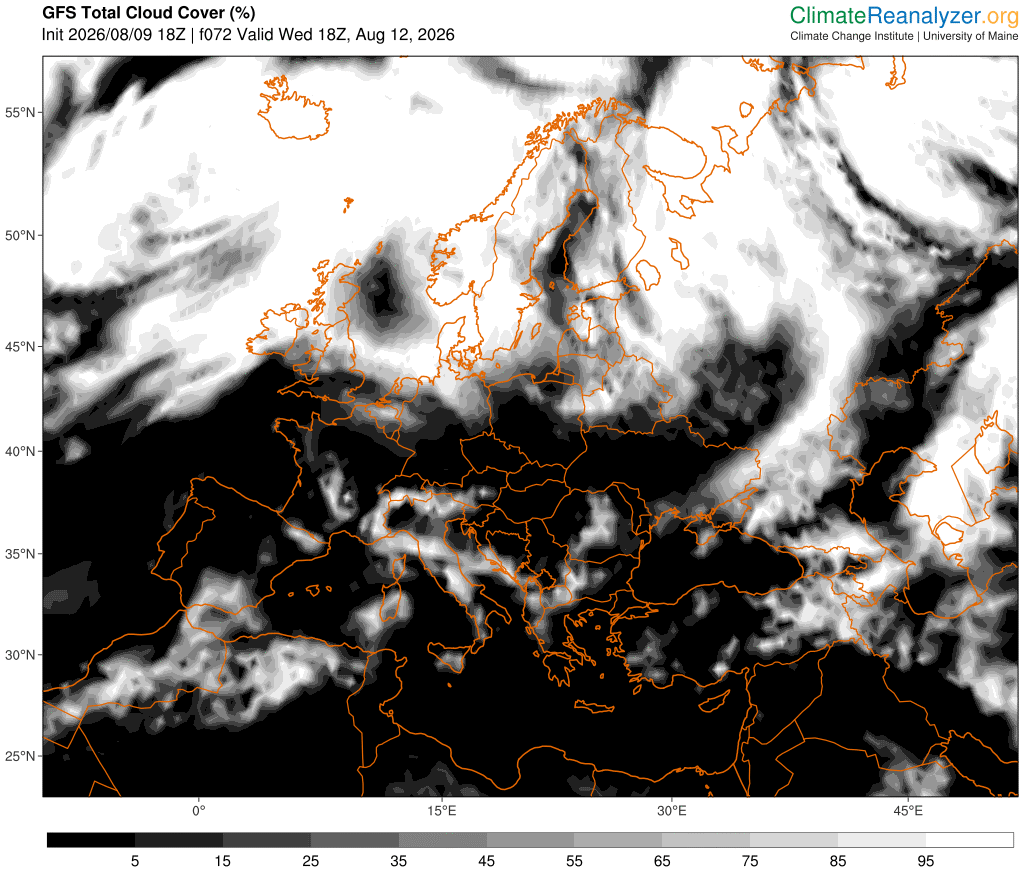
Image: Expected cloud cover from the GFS model on August 12th at 18 GMT. Many parts of Europe will have clear skies or only some (high) clouds. Iceland and northern parts of British Isles might see more clouds. Source: ClimateReanalyzer.org
If you miss this month’s eclipse, you will not have to wait very long for the next opportunity: on August 2, 2027, another total solar eclipse will be visible across the far south of Spain and northern Africa.