
Earth's oceans hit record temperatures as El Niño strengthens
Earth’s global average sea surface temperature has reached record-breaking high levels over the past week as El Niño gains strength in the tropical Pacific Ocean.
According to the ECMWF’s ERA5 dataset, Earth’s global average sea surface temperature reached 20.86°C on Sunday, June 21. This was the highest value on record for this time of year, beating the 20.83°C from the same date in 2023 and 2024, which were the two warmest years on record for global ocean temperatures.
Another highly-regarded dataset from NOAA – the OISST V2.1 – registered a global daily sea surface temperature of 20.97°C on June 21. This also beat that dataset’s previous record of 20.92°C from the same date in 2024.
It’s important to note that these near-real-time ocean temperature values are preliminary estimates and may be revised as the data is quality-controlled.
Why are the oceans so warm?
Two of the main drivers behind this month’s record-breaking ocean warmth are El Niño and climate change.
El Niño is associated with a large tongue of abnormally warm water in the central and eastern tropical Pacific Ocean. This year’s El Niño was declared earlier this month by NOAA and the BoM and sea surface temperatures in the central Pacific are currently about 1.7°C above the 1991-2020 average. This exceptionally warm water is helping push the global average ocean temperature to record high levels.
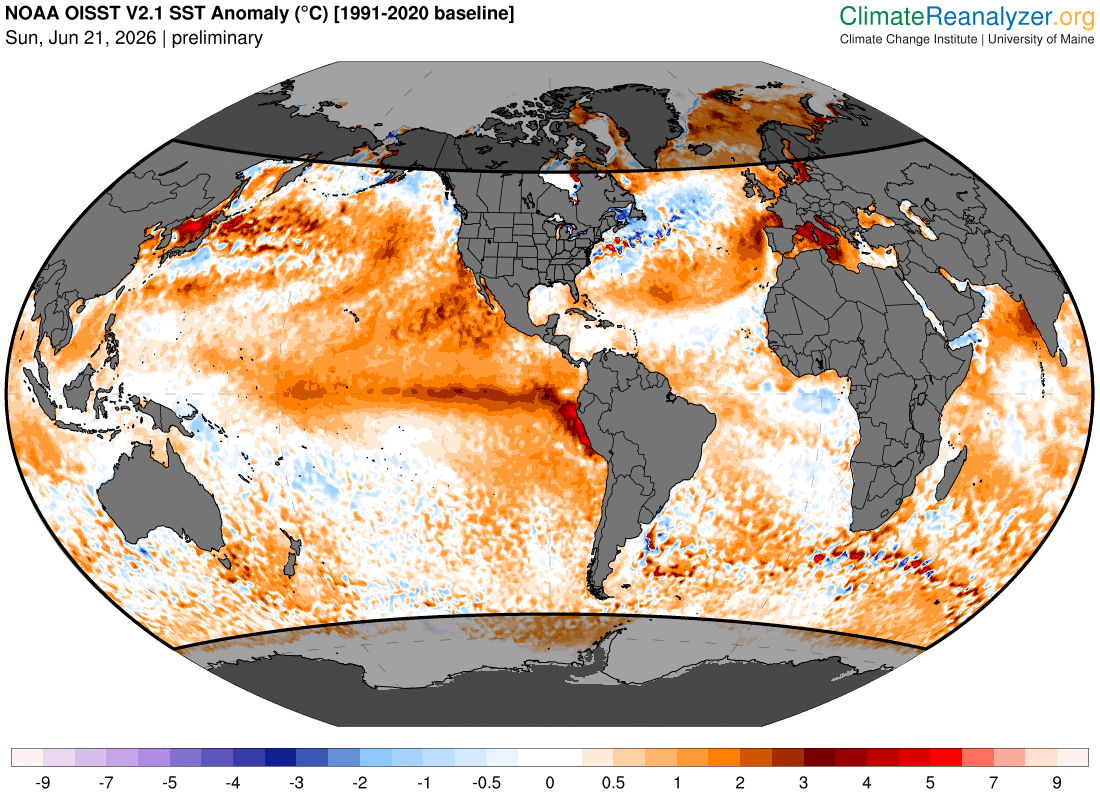
Image: Global sea surface temperature anomalies on Sunday, June 21, 2026, according to the NOAA OISST V2.1 dataset. The polar regions shaded in black are excluded when calculating the global average ocean temperature, primarily to exclude areas covered by sea ice.
In addition to the influence of El Niño, most ocean basins across the globe have been getting warmer in recent decades in response to climate change. According to NOAA, the global ocean average temperature increased by around 0.77°C from 1970 to 2025, which is about 0.14°C per decade.
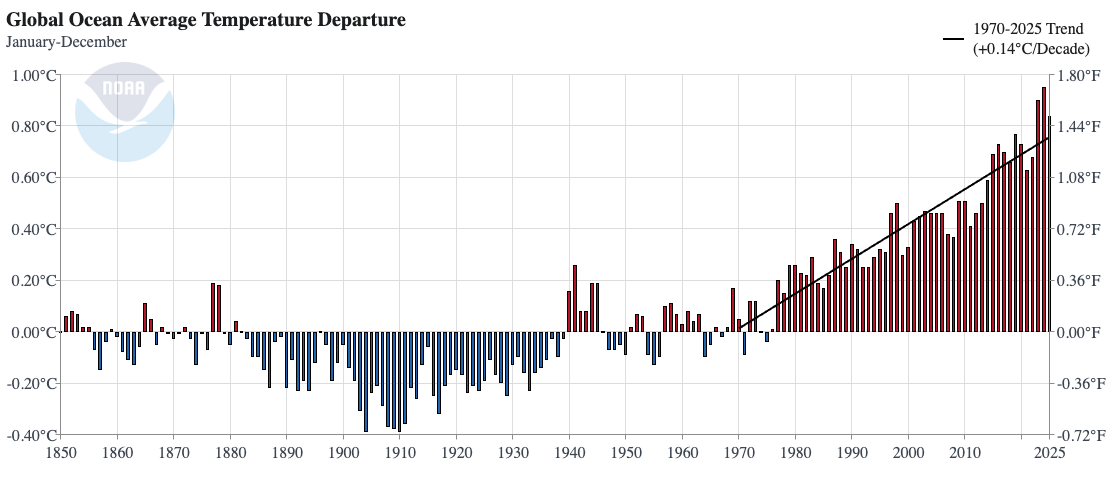
Image: Global ocean annual average temperature anomalies, relative to the 1901-2000 climate. The trend for the period from 1970 to 2025 is shown, during which time the temperature rose by 0.14°C per decade. Source: NOAA NCEI, Climate at a Glance / NOAAGlobalTemp
What does this mean for 2027?
This year’s brewing ocean warmth – underpinned by El Niño – is likely to linger beyond the end of 2026 and could push global temperatures, in both the ocean and atmosphere, to new heights in 2027. According to Dr Leon Hermanson from the UK Met Office, “there is an El Niño predicted for the end of 2026, which increases the chances of the following year, 2027, being the next record-breaking year.”