
Darwin wet season was 4th-soggiest on record
The Top End wet season comes to an end with clear skies and dry conditions across virtually the entire Northern Territory this Thursday, but it was a very soggy season in many locations, and not least in Darwin.
The Top End wet season officially runs from the start of October to the end of April. To 9am this Thursday, April 30 (in the unlikely event of rain after 9am, it will be counted in May’s total) Darwin recorded:
- 2397.4mm of rainfall across the wet season, which made it the 4th-wettest on record. The average across the season in 157 years of records is 1691.7mm.
- Above-average rainfall in each of the last six months of the season from November through April. The only other time that happened was in 2016/17.
It’s worth noting that all five of Darwin’s dampest wet seasons have occurred since the 1990s. Climatologists have identified a trend of gradually increasing wet season rainfall, and this is considered to be a signal related to climate change.
Apart from Darwin, numerous other locations in the Top End also experienced consistently wetter-than-usual conditions in the 2025/26 wet season.
For example, the weather station at Cape Wessel at the far northeastern tip of Arnhem Land recorded 513.4mm of rainfall in December and 639.8mm in January. The December figure was a record, while January came close.
Indeed, a few small areas recorded in both the NT Top End and Queensland's Cape York received their heaviest rainfall totals on record across the duration of the wet season.
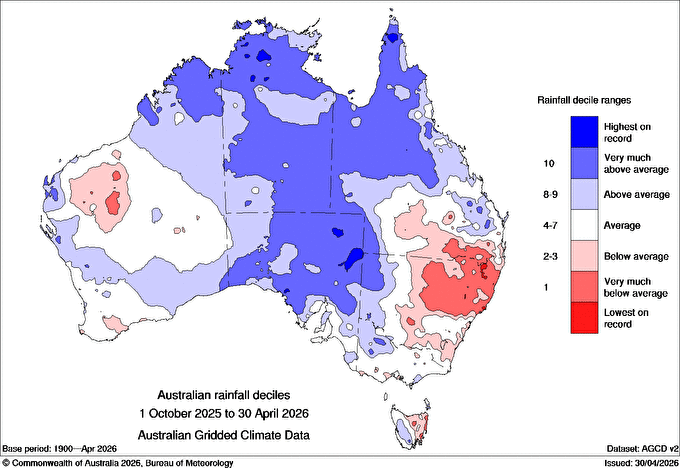
Image: Rainfall deciles across Australia from the start of October 2025 to the end of April 2026. Some parts of Qld and the NT experienced record wet season rainfall totals for the duration of the seven-month season. Source: BoM.
Why was the Top End wet season so wet?
Numerous slow-moving tropical lows generated persistent rainfall over prolonged periods, while tropical cyclones also played a significant role in rainfall totals, especially Fina in November and Narelle in March,
In particular, Severe Tropical Cyclone Narelle had a strong influence on rainfall totals during the 2025/26 Top End wet season.
Narelle made landfall in three states during March. Its first landfall was in Far North Queensland, its second was in the NT Top End, while its third was in the northwest of Western Australia.
That second landfall brought copious amounts of rain to the territory and caused severe flooding in and around places like Katherine.
Darwin and Katherine (300km SE of Darwin) both exceeded 500mm of rainfall in March. This made it the wettest month of the 2025/26 wet season in both spots, even though March is on average Darwin’s 3rd-wettest and Katherine’s 4th-wettest wet season month.
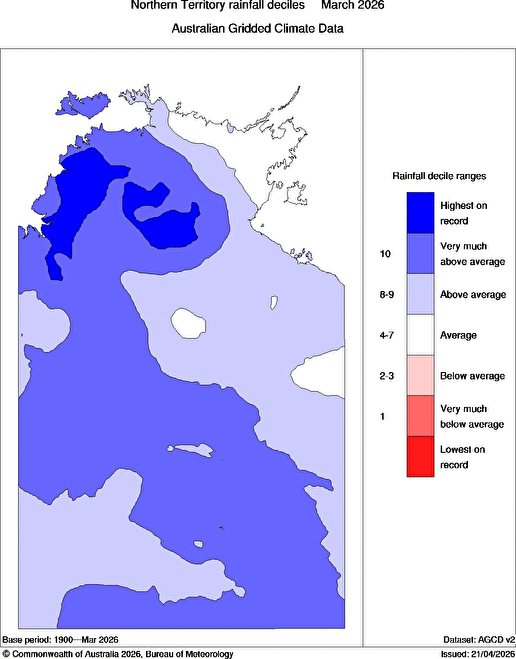
Image: Rainfall deciles for the Northern Territory in March, 2026. The dark blue areas represent the heaviest March monthly totals on record. Source: BoM.
Can it still rain during the rest of the year in the Top End?
With the dry season upon us, that doesn’t mean the rain taps totally turn off until October – although that can happen in the winter months.
On average, Darwin receives 20.2mm, 1.7mm, 1.1mm, 4.5mm, and 16.8mm of rainfall in May, June, July, August and September respectively. But last year, the city received not a drop in June, July and August, which is not unusual.