
Careless climate reporting could have unintended consequences
This week’s widespread media coverage about the potential collapse of a major ocean current has highlighted a risky tactic in mainstream climate change reporting.
In many cases, media have accurately reported a new study that suggests the Atlantic Meridional Overturning Circulation (AMOC) could collapse around the middle of this century.
Unfortunately, some reports have put excessive focus on the earliest possible date mentioned in the study, leading audiences to believe that a major climate tipping point will be passed in two years’ time.
First things first, what is the AMOC?
The AMOC is a large-scale circulation of water in the Atlantic Ocean, which is characterised by a northward flow of warm, salty water near the surface and a southward flow of colder water at depth.
The AMOC forms the northern limb of a persistent pattern of water flow throughout our planet’s oceans, which is called the ‘thermohaline circulation’ and is sometimes referred to as the ocean conveyor belt.
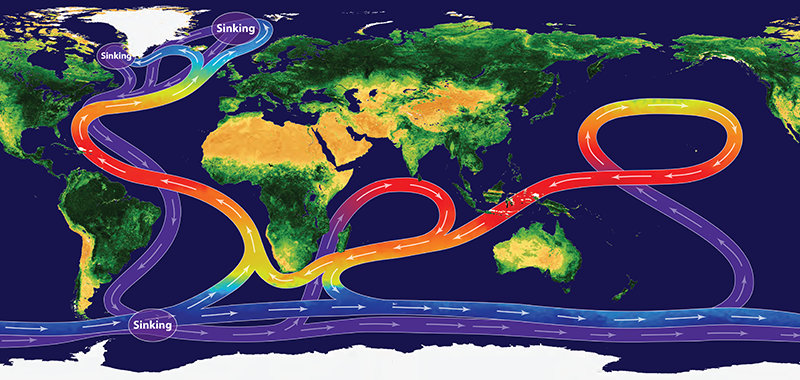
Image: A schematic representation of the global ocean conveyor belt. Source: National Oceanography Centre
The AMOC and the global thermohaline circulation both play critical roles in maintaining life on Earth as we know it. If the AMOC were to shut down, it would likely have a significant impact on our weather, environment and economy, and may trigger other climate tipping points.
Why is everyone talking about the AMOC this week?
A Danish study published in the journal Nature Communications this week estimates that the AMOC could collapse in the next few decades. This prediction is much earlier than the Intergovernmental Panel on Climate Change’s (IPCC) estimate for a potential AMOC collapse.
According to the IPCC, “The AMOC will very likely weaken over the 21st century (high confidence), although a collapse is very unlikely (medium confidence).
“By 2300, an AMOC collapse is as likely as not for high emission pathways and very unlikely for lower ones, highlighting that an AMOC collapse can be avoided in the long term by CO2 mitigation (medium confidence).”
However, the newer study from the University of Copenhagen finds that the AMOC shutdown could come much sooner.
“We estimate a collapse of the AMOC to occur around mid-century under the current scenario of future emissions,” say the authors.
According to the Danish researchers, the shutdown of the AMOC will happen sometime between 2025 and 2095, but most likely around 2050.
It is important to point out here that the study is predicting the AMOC shutdown to occur around 2050, in the middle of this century. However, due to the uncertainty in the modelling, there is a statistically significant error range of plus or minus 45 years (hence the upper and lower bounds of 2025 and 2095).
Coverage in the media
Understandably, new research predicting an AMOC shutdown this century is cause for global attention. This has led to widespread international media coverage over the last 48 hours.
However, there has been a key difference in how various news organisations are framing their headlines and opening statements.
While some publications focus on the finding that the middle of this century is the most likely time for an AMOC shutdown, others have led with 2025 as the potential tipping point. A few examples of mid-century as the lead focus can be found here and here, while some of the 2025-focussed media can be seen here, here and here.
This contrast in reporting styles highlights a tactic often used throughout mainstream media when reporting on climate change news: lead with the most attention-grabbing figure and explain the nuance deeper into the story.
This approach aims to maximise engagement. However, it also risks readers misinterpreting important facts, especially for casual readers that only skim the headline and the first paragraph.
Based on the results of the study released in Nature this week, the AMOC is statistically unlikely to shut down in 2025, because this is the lower bound of the 95% confidence interval. But for the people that have seen 2025 mentioned in headlines this week, some will now expect a major tipping element in our climate system to occur in two years' time, which is unlikely.
This style of reporting may have a negative impact on people’s broader trust for climate change science. Every time they perceive a climate prediction to be wrong, their confidence in climate science takes a hit.
The media plays an important role in keeping people informed about ongoing developments in climate change science, but care should be taken when deciding how to frame the story.