
44 days of record warm global ocean temperatures
Earth’s oceans have been running at record warm levels for 44 consecutive days, putting April on track to become our planet’s warmest month in history based on global sea surface temperature.
The graph below shows daily global sea surface temperatures since 1981, based on a dataset from NOAA that incorporates observations from satellites, ships, buoys and Argo floats.
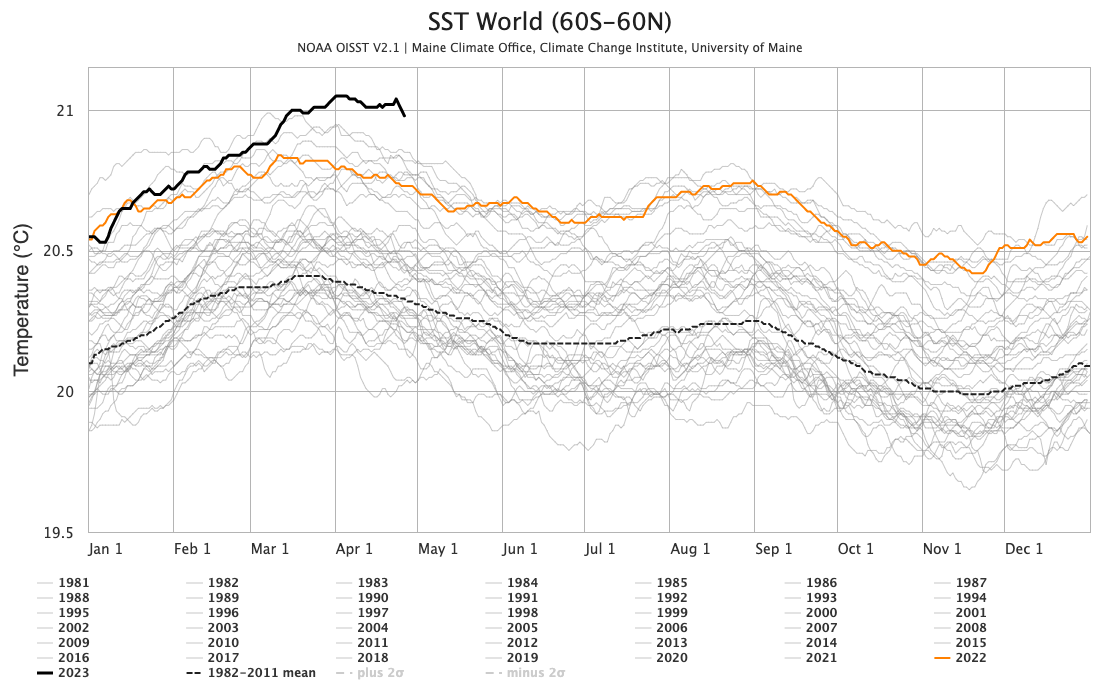
Image: Daily global sea surface temperature observations between 1981 and 2023, according to NOAA’s OISST V2.1 dataset. Source: ClimateReanalyzer.org
Each thin grey line represents a single year, with 2022 highlighted orange, and the dashed line showing the long-term average global sea surface temperature based on all years between 1982 and 2011.
The dark black line near the top of the graph is 2023. This line has been tracking above any previously recorded value since March 14, with April 26 marking the 44th consecutive day of record-breaking global sea surface temperatures.
This is a remarkable run of unrivalled sea surface temperatures, made even more ominous by the fact that it is occurring in the absence of El Niño.
When El Niño is active in the Pacific Ocean, global sea surface temperatures usually increase do the large amount of surface warming in the tropical Pacific. While there is strong consensus between global forecast models that El Niño is likely to develop later this year, it is not yet in place.
If El Niño does develop in 2023, this will likely cause more anomalous warming in the Pacific Ocean, which may help extend the current run of record warm ocean global temperatures through the middle of 2023.
You can track the global ocean temperatures here.