
42C at 5:25am - torrid night sets new US minimum temperature record
Another heat record has been broken in North America as the latest in a string of blistering summer heatwaves grips the western United States.
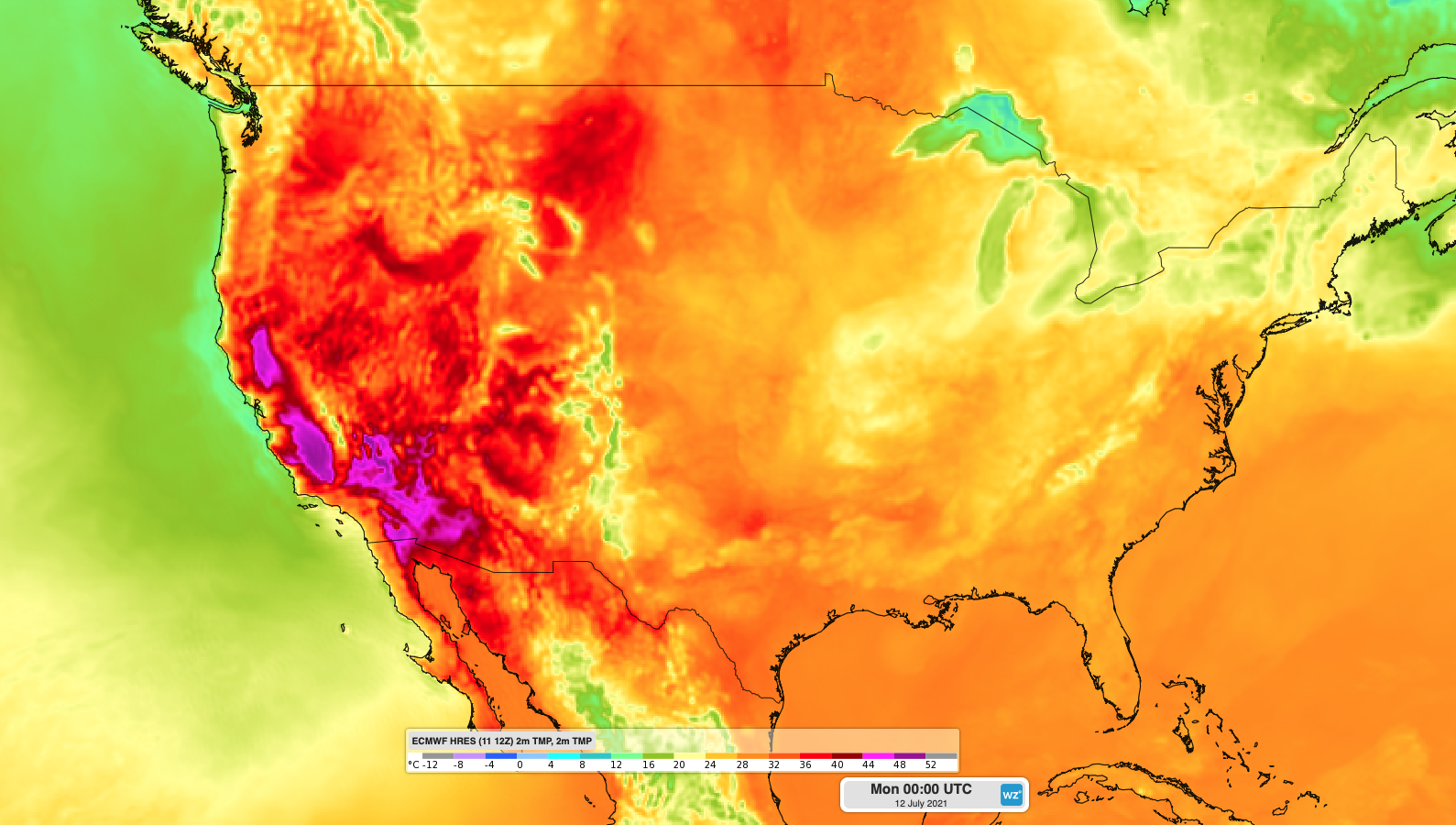
Image: Modelled surface air temperature on Sunday afternoon, according to the ECMWF model, showing intense heat gripping parts of the Western US.
A weather station at Stovepipe Wells, located in California's Death Valley National Park, registered a preliminary minimum temperature of 42.0ºC on Sunday, July 11. If verified, this will be the highest minimum temperature on record for the United States.
Lending some credibility to the observation is that this site is one of the country's Climate Reference Network weather stations. This network of climate monitoring stations is managed and maintained at a high standard by the National Oceanic and Atmospheric Administration (NOAA).
Not only is this scorching 107.7°F the warmest daily low in U.S. history, assuming it holds till midnight (a safe bet), but it was recorded at one of the nation's gold-standard Climate Reference Network stations:https://t.co/GgQCmhmYFZ https://t.co/kfhqPyE2DN
— Bob Henson (@bhensonweather) July 11, 2021
Stovepipe Well's temperature profile on Saturday night into Sunday morning was exceptional:
Midnight: 46.9ºC
- 2am: 46.1ºC
- 4am: 44.9ºC
- 6am: 43.6ºC
According to data published by the NOAA, the mercury dipped to 42.1ºC at 5:25am and 7:30am on Sunday, although the daily minimum temperature listed on their website was 42.0ºC for June 11.
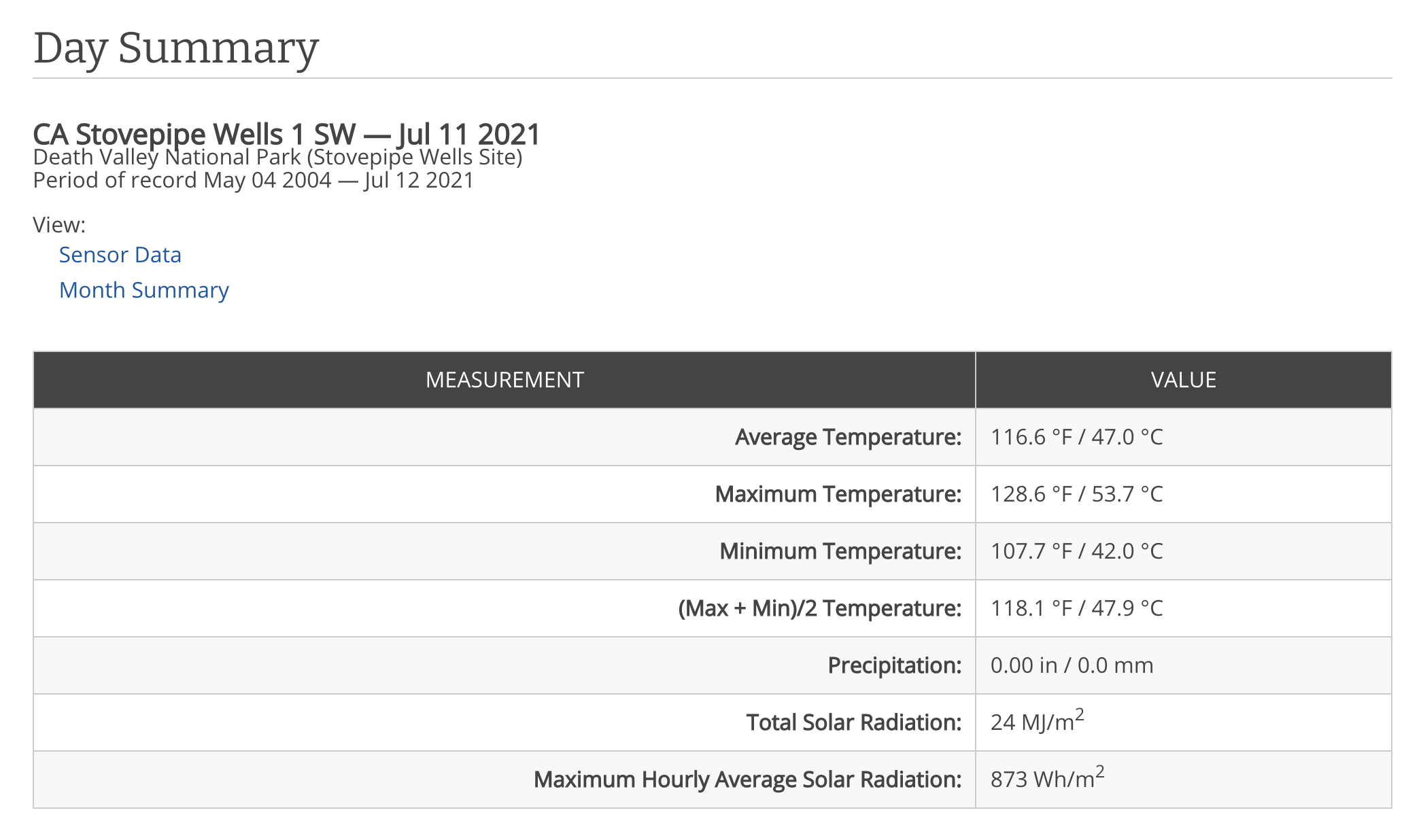
Image: Daily temperature extremes at Stovepipe Wells, California on June 11, according to the NOAA. Source: NOAA USCRN
But while this was a new US record, it's not the highest minimum temperature in the world.
The World Meteorological Organization doesn't maintain records for highest minimum temperature. However, many weather historians recognise 44.2ºC at Khasab Airport, Oman on June 17, 2017 as our planet's highest overnight temperature ever reliably recorded.
Another standout temperature from this current heatwave was 54.4ºC at Furnace Creek in Death Valley on Friday, July 9. While this falls short of the official WMO-recognised world record maximum temperature of 56.7C from the same location in 1913, there is also some doubt amongst the weather history community about the legitimacy of that 1913 record.
The WMO acknowledges the suspicion around the current world record, stating in August 2020 that "the WMO Archive for Weather and Climate Extremes is always willing to investigate any past extreme record when new credible evidence is presented."
The weekend also saw the state of Utah match its all-time maximum temperature record when a weather station at St George reached 47.2ºC.
This heatwave follows a separate record-breaking spell of hot weather that shattered records in the Northwest US and Western Canada at the end of June and early July.
Preliminary data suggests many daily max records were broken or tied Sat. due to the Southwest heatwave. Notable potential records: Las Vegas, NV tying its all-time record high, Winslow, AZ setting a new all-time record high, and St. George, UT tying Utah's all-time record high. pic.twitter.com/UoMsOWpdKs
— NWS Weather Prediction Center (@NWSWPC) July 12, 2021
Both of these recent heatwaves were caused by slow-moving upper-level high pressure systems. They were also likely influenced by climate change. A rapid attribution analysis showed that last month's unprecedented heat in Western Canada and the Northwest US would have been "virtually impossible" without human-caused climate change.