
How to see tonight's total lunar eclipse in Australia
A blood moon will be visible across cloud-free areas of Australia tonight, Tuesday March 3. Here’s how to watch the total lunar eclipse and which areas of the country will have the best view.
What is a lunar eclipse?
A lunar eclipse occurs when Earth becomes positioned between the Sun and the Moon, causing Earth’s shadow to shield the Moon from direct sunlight. This alignment causes the Earth-oriented face of the moon to appear red or orange as certain wavelengths of indirect sunlight are redirected towards the Moon’s surface by Earth’s atmosphere. The Moon’s red/orange colour during a total lunar eclipse is why it is also called a ‘blood moon’.
What to expect during a lunar eclipse?
The most visible part of this week’s lunar eclipse will last for around three hours in Australia.
This will start with a phase called the partial eclipse as the Moon begins to move into the central, darkest part of Earth’s shadow, which is called the umbra. This phase of the eclipse looks like a huge bite is being taken out of the moon and it gradually gets larger as more of the Moon enters Earth’s umbra.
The next phase of the eclipse is called the total eclipse, which occurs when the whole moon is positioned inside Earth’s umbra. While the moon gradually turns red or orange towards the end of the partial eclipse phase, the strongest colour is seen during the total eclipse.
Following the total eclipse, the Moon will gradually exit Earth’s umbra and pass through a second partial eclipse phase. This will cause the Moon to return to its normal colour and gradually grow back into a regular full moon as it moves out of Earth’s shadow.
Each of these three phases will last for around one hour on Tuesday night.
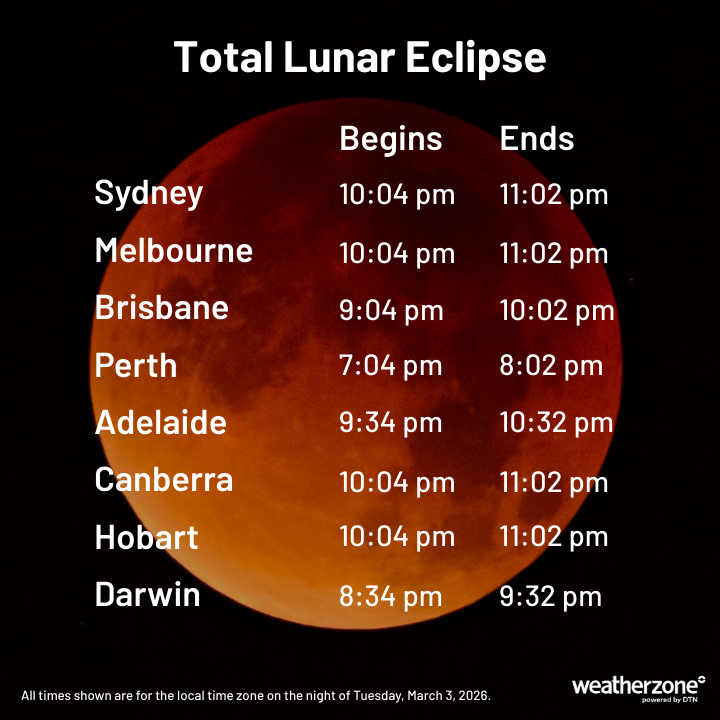
Image: Total lunar eclipse times for Australian capital cities. Partial eclipses will occur for roughly one hour on either side of the times mentioned here. Source: Weatherzone.
Where will there be cloud during the eclipse?
Total lunar eclipses are safe to watch with a naked eye and can also be viewed using binoculars or a telescope. The main thing that will spoil your view of a blood moon is cloud.
Large areas of northern Australia will be covered with cloud on Tuesday night due to an active monsoon trough in the tropics. This could prevent Darwin, Cairns and Broome from seeing part or all of the eclipse.
The remnants of the low pressure system that caused flooding rain across central Australia in the past week will also bring cloudy skies to parts of southeastern Australia on Tuesday night. This will obstruct the view of the blood moon in parts of New South Wales, Victoria, Tasmania and the Australian Capital Territory.
Some lingering cloud over central Australia could also spoil the show in areas of southwest Queensland and some southern areas of the Northern Territory.
Most other areas of southern and western Australia will be cloud-free on Tuesday night.
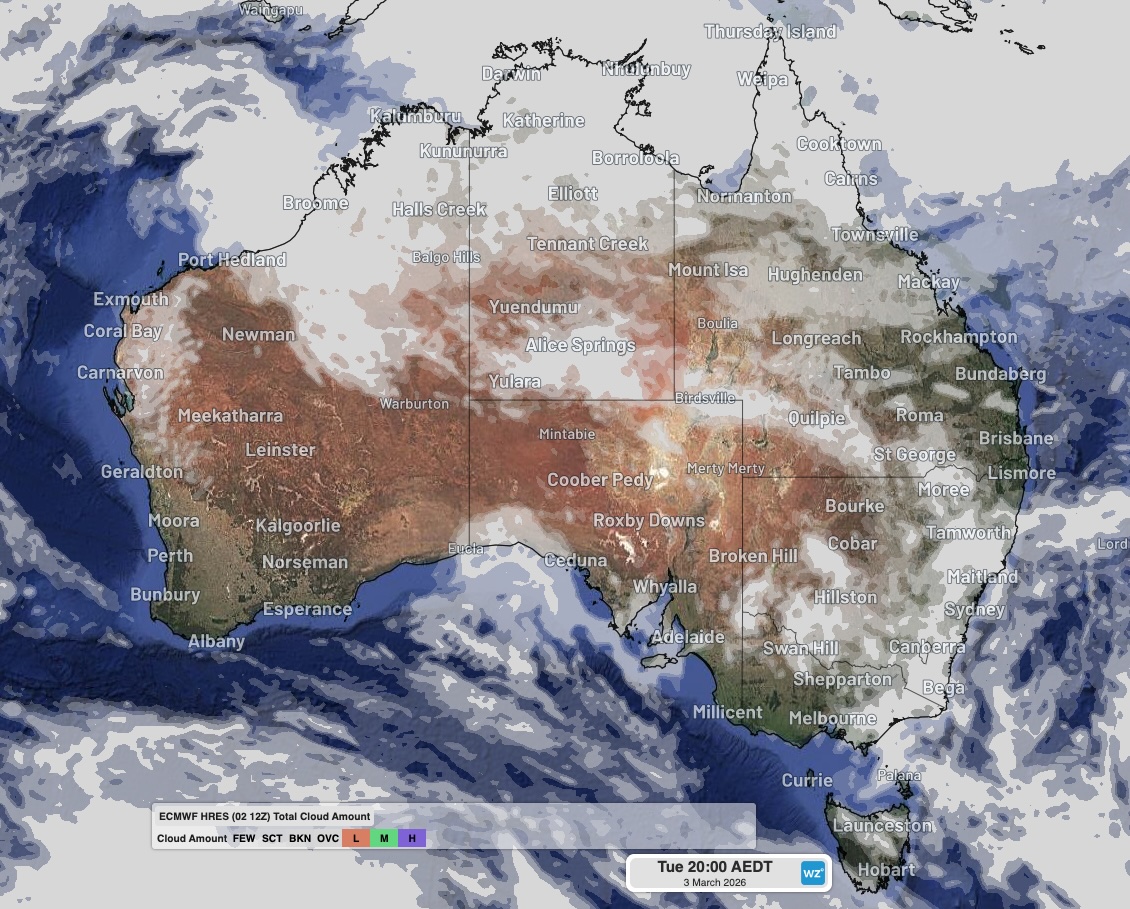
Image: Modelled cloud cover at 8pm AEDT on Tuesday, March 3, 2026. Source: Weatherzone.
You can check local cloud cover forecasts and track the latest satellite observations in the Weatherzone app.
When is the next eclipse in Australia?
If you miss Tuesday night’s eclipse, you’ll have to wait nearly three years to see the next blood moon in Australia. The next total lunar eclipse will occur on the night of December 31, 2028 into the early hours of January 1, 2029.
Another big eclipse to put in the diary is a total solar eclipse on July 22, 2028. Parts of Australia, including Sydney, will get to witness day suddenly turn to night as the Moon completely covers the face of the Sun for just under four minutes.